
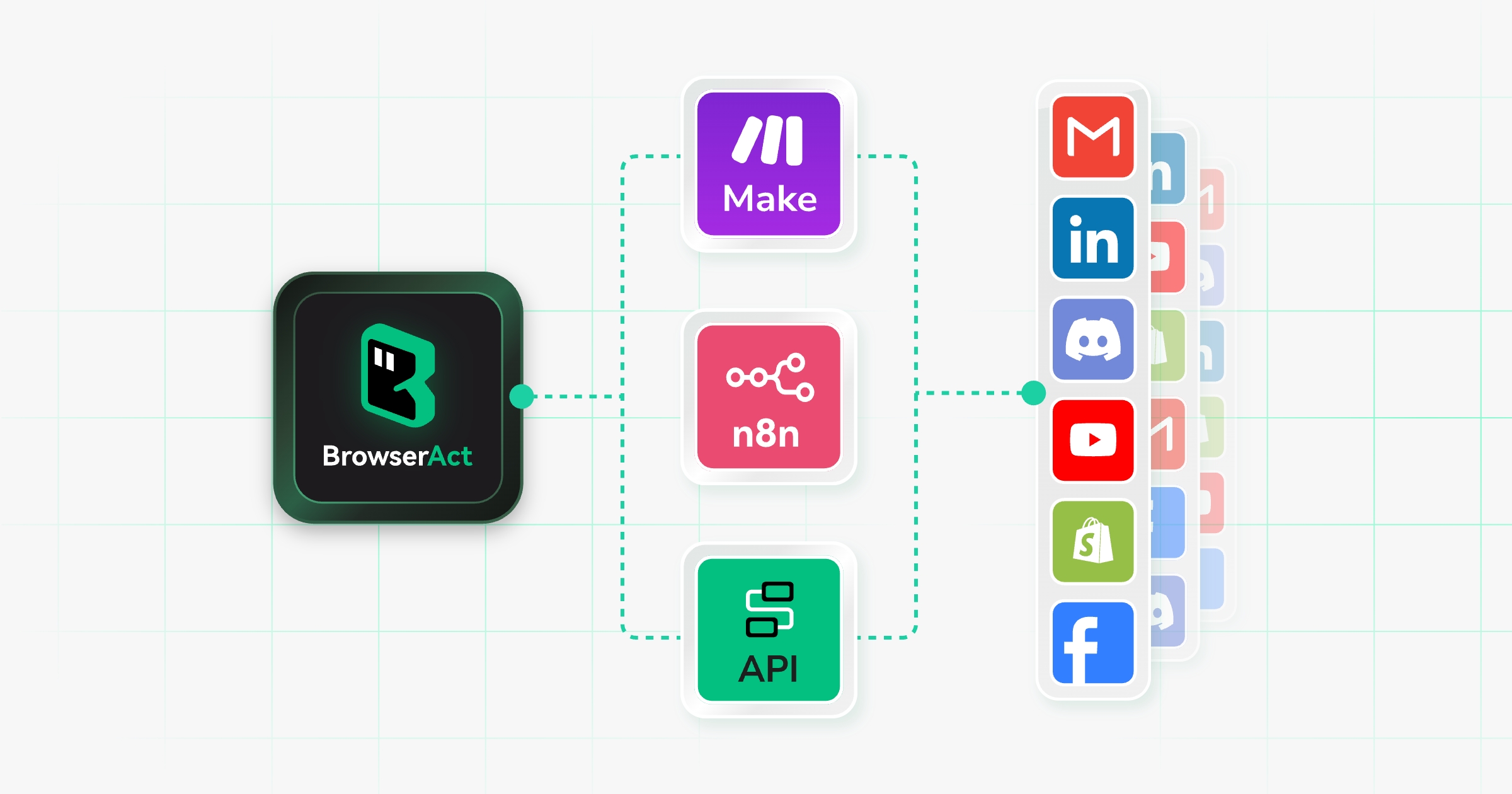
BrowserAct | Give AI agent the power to use the web
BrowserAct provides AI agents with a managed browser layer to extract live web data, handle CAPTCHAs, and execute end-to-end web tasks securely.
Overview
What is BrowserAct
BrowserAct is an AI agent infrastructure tool designed to bridge the gap between large language models and the live internet. It provides a fully managed browser environment that allows AI agents to navigate websites, extract structured data, and perform complex interactions that typically require human intervention. The platform addresses common challenges in web automation, such as anti-bot detection, CAPTCHA solving, and session management, enabling agents to operate reliably across diverse web environments.
The core value proposition of BrowserAct is its ability to "give AI agents the power to use the web." By integrating directly into agent workflows, it allows models like Claude or custom LLMs to execute browser-based skills. This includes launching browsers in stealth mode, handling dynamic content, and returning clean, structured data for further reasoning or storage. The tool is positioned as a critical layer for agentic AI applications that need real-time, live web access rather than relying solely on static datasets or pre-crawled information.
Key Features
BrowserAct offers several technical capabilities tailored for autonomous agents:
- Stealth Mode Browsing: The system launches browsers with unique fingerprints and session isolations to mimic legitimate human users, reducing the likelihood of being blocked by standard anti-bot measures.
- Automated CAPTCHA Handling: One of the most significant hurdles for web-scraping agents is CAPTCHA verification. BrowserAct includes built-in CAPTCHA solving capabilities, allowing agents to bypass security checks automatically without human hand-off.
- Proxy Integration: The platform supports various proxy types, including dynamic residential proxies and static dedicated IPs. This ensures global coverage, country-level targeting, and high success rates for accessing geo-restricted content.
- Session Isolation: Each agent instance or user account can maintain unique browser profiles with full session and cookie isolation. This prevents cross-contamination of data and allows for parallel task execution.
- Skill-Based Architecture: BrowserAct integrates via "skills" (e.g.,
browser-act). Agents can install these skills to gain immediate access to browser controls, scraping tools, and export functions. - Data Export: The tool supports exporting scraped data into standard formats like CSV, facilitating easy ingestion into downstream applications or databases.
Use Cases
BrowserAct is suitable for a variety of AI-driven workflows that require live web interaction:
- Market Research and Competitive Intelligence: Agents can monitor competitor pricing, product availability, and customer reviews in real-time. For example, an agent can scrape Amazon bestseller lists, capturing product names, prices, and review counts, then export this data for analysis.
- Lead Generation: Sales AI agents can navigate professional networks or business directories to find contact information, verifying leads through live site interaction while managing login states.
- Automated Data Entry and Form Submission: For tasks requiring interaction with web forms, BrowserAct’s ability to handle sessions and CAPTCHAs makes it ideal for automating repetitive data entry processes.
- Content Monitoring: News aggregators or monitoring agents can track specific websites for updates, ensuring they capture the latest information as it appears, rather than relying on delayed RSS feeds.
Pricing Overview
BrowserAct operates on a credit-based system, allowing users to pay for infrastructure services as they consume them. This model is designed to scale with usage, particularly for agents that may have variable workloads.
- Free Trial: A 7-day free trial is available, which includes 100 credits with any subscription plan. This allows developers to test the integration and functionality before committing financially.
- Local Fingerprint Browser: Priced at approximately $0.064 per browser instance (100 credits). This option provides unique browser profiles with full session isolation.
- Dynamic Proxy: Costs around $3.2 per GB (5,000 credits per GB). This feature offers worldwide coverage with real residential IPs and auto-rotation capabilities.
- Workflow Steps: Basic workflow execution is priced at roughly $0.0032 per step (5 credits). This covers AI-powered task execution and remote browser scheduling.
- Cloud Browser: Currently listed as "Coming Soon" with pricing to be determined. This feature promises elastic cloud scaling and zero local hardware consumption.
- Static Proxy: Priced per proxy per month, varying by location and tier. These are dedicated long-term IPs ideal for account management.
Users can also purchase infrastructure services using their existing credit pools, suggesting a flexible billing structure for enterprise or high-volume users.
Who Should Use It
BrowserAct is primarily targeted at AI developers, data engineers, and enterprises building agentic workflows. It is particularly useful for teams using frameworks like LangChain, AutoGen, or custom LLM applications that require robust web interaction capabilities.
The tool is ideal for organizations that have struggled with traditional scraping methods due to anti-bot protections. By handling CAPTCHAs and stealth browsing internally, BrowserAct reduces the engineering overhead required to maintain reliable web scrapers. Additionally, its integration with major cloud providers (AWS, Azure, Google Cloud, etc.) suggests it is well-suited for enterprise environments that require scalable, secure, and compliant data extraction solutions.
For more details on similar agent infrastructure tools, explore our ToolSeekAI tools directory. You can also compare BrowserAct against other competitors in our rankings section.
Evaluation Context
Onboarding Flow:
The onboarding process appears streamlined for developers. Users can start with a free trial to receive initial credits. Integration involves installing a specific skill (e.g., browser-act) into the agent environment. The provided demo shows a seamless command-line interface where the agent initiates the browser, detects CAPTCHAs, solves them, and exports data, indicating a low-friction setup for technical users.
Integration Considerations: BrowserAct is designed to work alongside existing AI frameworks. The demo highlights compatibility with tools like Claude Code, suggesting it can be embedded into development workflows easily. However, users should ensure their agent architecture supports skill-based plugins or API calls to manage the browser instances effectively.
Data and Privacy: The platform emphasizes session isolation and unique fingerprints, which helps maintain privacy and prevents data leakage between different tasks or users. The use of residential proxies adds a layer of anonymity but users should verify compliance with the terms of service of the websites they are scraping, as automated access may still violate certain site policies.
Pricing Verification Checklist:
- Confirm current credit values and exchange rates.
- Check if dynamic proxy costs are billed separately or included in workflow steps.
- Verify the release date and final pricing for the upcoming Cloud Browser feature.
- Ensure the 7-day trial credits are sufficient for basic testing of all features.
Comparison Criteria: When evaluating BrowserAct against alternatives, consider factors such as CAPTCHA solving accuracy, proxy success rates, ease of integration with popular LLM frameworks, and cost-per-task efficiency. The ability to handle complex, multi-step web interactions without manual intervention is a key differentiator.
For further reading on agent capabilities, visit the BrowserAct Docs or join the community on Discord.
FAQ
What is BrowserAct? BrowserAct is an AI agent infrastructure tool that provides a managed browser environment for extracting live web data, handling CAPTCHAs, and executing end-to-end web tasks.
Does BrowserAct offer a free trial? Yes, BrowserAct offers a 7-day free trial with 100 credits included with any subscription plan.
How does BrowserAct handle CAPTCHAs? BrowserAct includes built-in CAPTCHA solving capabilities, allowing agents to bypass security checks automatically without human intervention.
What types of proxies are supported? The platform supports Dynamic Residential Proxies, Static Dedicated Proxies, and one-click proxy assignments for local fingerprint browsers.
Is there a Cloud Browser option? A Cloud Browser feature is currently listed as "Coming Soon" with pricing to be determined. It will offer elastic cloud scaling and zero local hardware consumption.
Can I integrate BrowserAct with my existing AI agent?
Yes, BrowserAct integrates via skills (like browser-act) and is compatible with frameworks that support plugin-based architectures, such as Claude Code.
Why it stands out
- Handles CAPTCHAs and anti-bot measures automatically.
- Offers a 7-day free trial with 100 credits.
- Supports multiple proxy types including residential and static.
- Integrates easily via skills for AI agents.
- Provides full session and cookie isolation.
Watch before using
- Cloud Browser feature is not yet released.
- Pricing is credit-based, which may vary in complexity.
- Requires technical integration for agent workflows.
- Static proxy pricing varies by location and tier.
- No specific enterprise SLA details provided in source.
FAQ
What is BrowserAct?
Does BrowserAct offer a free trial?
How does BrowserAct handle CAPTCHAs?
What types of proxies are supported?
Is there a Cloud Browser option?
Can I integrate BrowserAct with my existing AI agent?
Related tools and alternatives
View all alternativesCoding
Cursor
Cursor is an AI-native code editor that embeds deep repository awareness into the development workflow, enabling multi-file refactoring, code generation, and debugging without context switching.
Coding
Replit
Replit is a browser-based IDE with built-in AI coding assistants, real-time collaboration, and one-click deployment. Ideal for rapid prototyping, education, and AI agent development without local setup.
Coding
GitHub Copilot
GitHub Copilot is an AI-powered pair programmer that suggests code, debugs, and automates tasks across multiple languages and IDEs, integrating deeply with GitHub workflows for individuals, teams, and enterprises.
Coding
Google Antigravity 2.0
Google Antigravity 2.0 is a playful April Fools' joke from Google Developers. It is not a real software tool, API, or developer resource, but rather a humorous web experience.
Coding
Gemma 4
Gemma 4 is Google's latest open-weight large language model series, designed for advanced reasoning, coding, and multimodal tasks with optimized efficiency for enterprise and developer deployment.
Coding
Bluerails: AI Agent Payment Infrastructure & Commerce
Bluerails provides payment infrastructure for the agentic economy, enabling AI agents to discover, act on, and pay businesses directly via agent-ready checkout and global settlement.
Site Discovery
Explore more on ToolSeekAI
Keep moving through tools, use cases, models, news, and rankings to turn one visit into a complete AI discovery path.