
Gemma 4
Gemma 4 is Google's latest open-weight large language model series, designed for advanced reasoning, coding, and multimodal tasks with optimized efficiency for enterprise and developer deployment.
Overview
What is Gemma 4
Gemma 4 represents the latest evolution in Google’s family of open-weight large language models (LLMs). Developed by Google DeepMind, this series continues the company’s commitment to providing high-performance, accessible AI foundations for researchers, developers, and enterprises. Unlike its predecessors, Gemma 4 is engineered to handle increasingly complex tasks while maintaining a focus on efficiency and safety.
The model series is available in multiple sizes, allowing users to select the variant that best fits their computational resources and performance requirements. By keeping the weights open, Google enables the community to fine-tune, adapt, and deploy these models on various hardware infrastructures, from cloud environments to edge devices. This openness fosters innovation and allows for greater customization compared to closed-source alternatives.
For those exploring the broader landscape of generative AI, Gemma 4 serves as a robust foundation for building custom applications. You can compare its capabilities against other leading models by visiting our ToolSeekAI tools directory, which aggregates detailed evaluations of top-tier AI solutions. Additionally, developers interested in benchmarking performance can refer to our rankings to see how Gemma 4 stacks up in standardized tests.
Key features
Advanced Reasoning Capabilities Gemma 4 is optimized for complex logical reasoning and multi-step problem-solving. It demonstrates significant improvements in mathematical accuracy and code generation, making it suitable for technical workflows that require precision.
Multimodal Potential While primarily text-focused in many deployments, the underlying architecture supports extensions for multimodal inputs. This allows for versatile applications where text, image, or other data types may need to be processed in conjunction.
Efficient Architecture The model series includes variants designed for different resource constraints. Smaller versions offer high speed and low latency, ideal for real-time applications, while larger versions provide deeper contextual understanding for complex queries.
Safety and Alignment Google has integrated rigorous safety measures into Gemma 4. The models are aligned to reduce harmful outputs and adhere to ethical guidelines, ensuring safer interactions in production environments. This includes robust filtering mechanisms and improved handling of sensitive topics.
Open Weights As an open-weight model, Gemma 4 allows unrestricted access to its parameters. This transparency enables researchers to audit the model for biases and developers to integrate it seamlessly into existing pipelines without vendor lock-in.
Use cases
Software Development With strong coding capabilities, Gemma 4 is ideal for assisting developers in writing, debugging, and optimizing code. It can generate boilerplate, suggest refactoring options, and explain complex algorithms, thereby accelerating the software development lifecycle.
Data Analysis and Research Researchers can leverage Gemma 4 for summarizing large datasets, extracting insights from unstructured text, and performing preliminary data analysis. Its reasoning abilities help in drawing logical conclusions from complex information sets.
Customer Support Automation Enterprises can deploy Gemma 4 to power intelligent customer support chatbots. The model’s ability to understand nuanced queries and provide accurate, safe responses makes it a valuable asset for enhancing user experience and reducing operational costs.
Content Creation Marketers and writers can use Gemma 4 to draft articles, create social media posts, and generate creative copy. Its versatility allows for tone adjustment and style adaptation to meet specific brand guidelines.
For more inspiration on practical applications, explore case studies in our ToolSeekAI tools section, where we highlight successful implementations of similar AI technologies.
Pricing overview
License Structure Gemma 4 is distributed under an open license that permits free use for research and commercial purposes, subject to specific terms outlined by Google. Users are encouraged to review the official license agreement for details on acceptable use, attribution, and redistribution rights.
Infrastructure Costs While the model weights are free, running Gemma 4 incurs computational costs. These vary based on the chosen variant and deployment method. Cloud providers charge for GPU/TPU usage, while self-hosted solutions require investment in hardware. Estimated costs depend on token volume and inference frequency.
Support and Enterprise Services Google may offer premium support, managed services, or additional security features for enterprise clients through dedicated partnerships. These services are typically priced separately and should be verified directly with Google Cloud or authorized partners.
Note: Specific pricing tiers for enterprise support are not confirmed in the source. Users should consult ToolSeekAI tools for updated third-party hosting prices.
Who should use it
AI Researchers Academics and scientists benefit from the open weights and advanced reasoning capabilities, allowing for experimentation with new architectures and alignment techniques.
Software Engineers Developers seeking efficient, high-quality code assistance and integration into CI/CD pipelines will find Gemma 4 particularly useful due to its coding proficiency and ease of deployment.
Enterprises Companies looking to build proprietary AI applications with strong safety standards and customizable features can leverage Gemma 4 to maintain control over their data and model behavior.
Startups Resource-constrained startups can utilize smaller variants of Gemma 4 to prototype AI-driven products quickly and cost-effectively, scaling up as needed.
To evaluate if Gemma 4 fits your specific needs, consider comparing it with other models in our rankings section. Always verify integration compatibility and data privacy requirements before deployment.
Onboarding and Integration Considerations
Getting started with Gemma 4 involves downloading the model weights and setting up the inference environment. Google provides documentation and libraries to facilitate this process. Developers should ensure they have compatible hardware, such as TPUs or GPUs, depending on the model size selected.
Integration into existing applications requires careful consideration of API design and latency requirements. For large-scale deployments, optimizing batch processing and caching strategies can significantly improve performance.
Data Privacy and Security
Since Gemma 4 is open-weight, organizations must implement their own data governance policies. When deploying the model, ensure that sensitive data is handled securely, especially if using cloud-based inference services. Reviewing the model’s training data limitations and potential biases is also crucial for responsible AI usage.
Comparison Criteria
When evaluating Gemma 4 against competitors, consider factors such as reasoning accuracy, coding proficiency, response latency, and safety alignment. Benchmark results from independent sources can provide objective comparisons. Visit ToolSeekAI tools for detailed side-by-side analyses of top LLMs.
FAQ
Is Gemma 4 free to use? Yes, Gemma 4 is available under an open license that allows free use for research and commercial purposes, subject to specific terms.
What sizes are available? Gemma 4 comes in multiple sizes to cater to different performance and resource requirements, ranging from smaller, faster models to larger, more capable ones.
Can I use Gemma 4 for commercial projects? Yes, the open license permits commercial use, but users must adhere to the terms specified by Google, including attribution and acceptable use policies.
How does Gemma 4 compare to previous versions? Gemma 4 offers improved reasoning, coding, and safety features compared to earlier iterations, with optimizations for efficiency and scalability.
Where can I find documentation? Documentation and integration guides are available on the official Google DeepMind website and through partner platforms listed in our ToolSeekAI tools directory.
Is there enterprise support available? Enterprise support options may be available through Google Cloud or authorized partners. Specific pricing and service levels are not confirmed in the source and should be verified directly.
Why it stands out
- Open-weight license allows flexible commercial and research use.
- Strong reasoning and coding capabilities for technical tasks.
- Multiple model sizes optimize for different resource constraints.
- Integrated safety measures reduce harmful outputs.
- Backed by Google DeepMind, ensuring high-quality development.
Watch before using
- Specific enterprise pricing and support details are not confirmed.
- Requires significant computational resources for larger variants.
- Self-hosting demands expertise in model deployment and optimization.
- Data privacy policies depend entirely on the user's implementation.
- Limited direct comparison benchmarks against all competitors in source.
FAQ
Is Gemma 4 free to use?
What sizes are available?
Can I use Gemma 4 for commercial projects?
How does Gemma 4 compare to previous versions?
Where can I find documentation?
Is there enterprise support available?
Related tools and alternatives
View all alternativesCoding
Cursor
Cursor is an AI-native code editor that embeds deep repository awareness into the development workflow, enabling multi-file refactoring, code generation, and debugging without context switching.
Coding
Replit
Replit is a browser-based IDE with built-in AI coding assistants, real-time collaboration, and one-click deployment. Ideal for rapid prototyping, education, and AI agent development without local setup.
Coding
GitHub Copilot
GitHub Copilot is an AI-powered pair programmer that suggests code, debugs, and automates tasks across multiple languages and IDEs, integrating deeply with GitHub workflows for individuals, teams, and enterprises.
Coding
Google Antigravity 2.0
Google Antigravity 2.0 is a playful April Fools' joke from Google Developers. It is not a real software tool, API, or developer resource, but rather a humorous web experience.
Coding
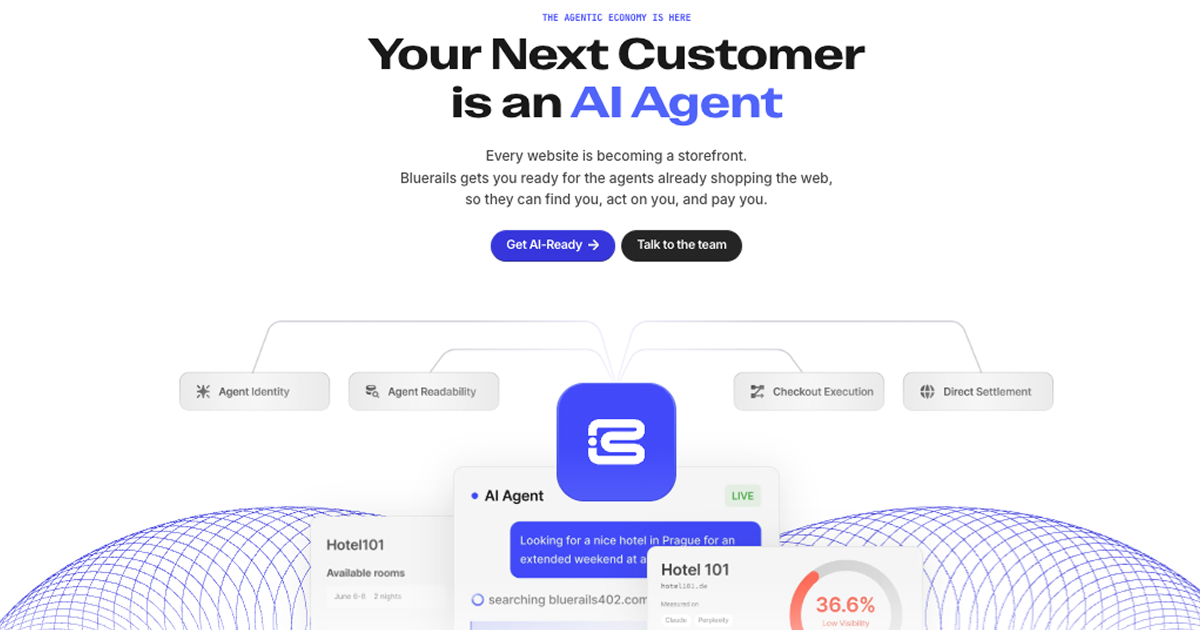
Bluerails: AI Agent Payment Infrastructure & Commerce
Bluerails provides payment infrastructure for the agentic economy, enabling AI agents to discover, act on, and pay businesses directly via agent-ready checkout and global settlement.

Coding
Cluely - Live AI Meeting Assistant | Real-Time Meeting Notes and AI Insights
Cluely is a live AI meeting assistant that provides real-time notes, instant answers, and insights during calls. It operates undetectably on your screen, supporting major platforms like Zoom and Teams without joining meetings as a bot.
Site Discovery
Explore more on ToolSeekAI
Keep moving through tools, use cases, models, news, and rankings to turn one visit into a complete AI discovery path.