
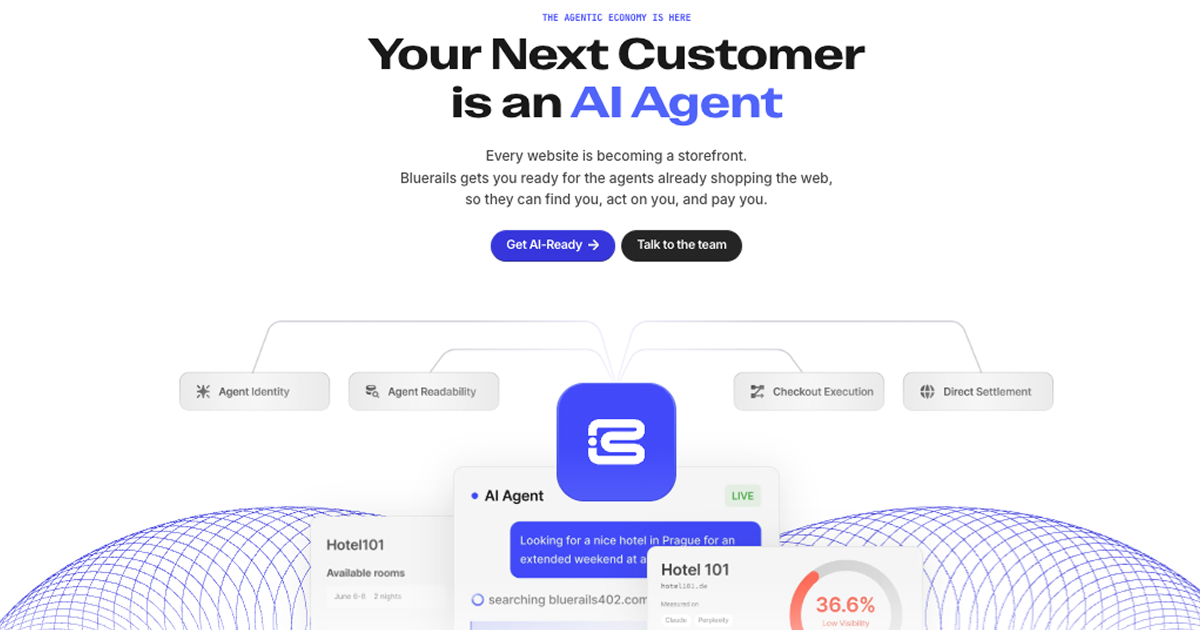
Bluerails: AI Agent Payment Infrastructure & Commerce
Bluerails provides payment infrastructure for the agentic economy, enabling AI agents to discover, act on, and pay businesses directly via agent-ready checkout and global settlement.
Overview
What is Bluerails?
Bluerails is a specialized payment infrastructure provider designed for the emerging "agentic economy." As artificial intelligence evolves from simple chatbots to autonomous agents capable of performing tasks, the way consumers interact with digital services is shifting. Bluerails positions itself as the bridge between human-facing websites and machine-to-machine commerce. Its core mission is to allow businesses to be "found, acted on, and paid" by AI agents.
Unlike traditional payment gateways that focus solely on processing credit card transactions for human users, Bluerails addresses the technical and financial requirements of automated agents. This includes making websites readable by machines, allowing agents to execute specific actions (like bookings or purchases) within defined boundaries, and handling global settlement across various currencies and markets. The platform claims that over 99% of current websites are not ready for this type of agentic commerce, creating a significant opportunity for early adopters who integrate Bluerails' infrastructure.
For more information on similar infrastructure tools, you can explore our ToolSeekAI tools directory. Additionally, you can check the latest rankings of AI payment solutions in our rankings section.
Key Features
Bluerails structures its offering around four primary pillars that facilitate agent-commerce:
-
Agent Identity: The platform provides real-time visibility into which AI agents are visiting a website. It tracks how often these agents crawl the site and whether they return, moving beyond static reports to live data. This helps businesses understand the demand from the agentic economy.
-
Agent Readability: To enable agents to understand a website, Bluerails offers "drop-in files and tags." These technical assets make the site's structure and content legible to machines, ensuring that agents can accurately interpret offerings, prices, and availability without human intervention.
-
Checkout Execution: This feature allows agents to act on a website within predefined boundaries. Businesses can set specific rules for what agents are permitted to do, such as completing a purchase or booking a service. This ensures that automation happens securely and according to the merchant's policies.
-
Global Settlement: Once an agent completes a transaction, Bluerails handles the financial side. This includes managing payments across different currencies and markets, ensuring that businesses get paid cleanly regardless of the agent's origin or the currency used.
The platform also emphasizes sub-cent transaction capabilities, noting costs as low as $0.001 per API call, which is critical for high-volume, low-value automated interactions.
Use Cases
Bluerails targets several industries where AI agents are likely to perform shopping or booking tasks autonomously:
- Travel & Hospitality: Hotels and accommodation providers can allow agents to find, compare, and book stays directly, bypassing traditional Online Travel Agencies (OTAs). This reduces dependency on intermediaries and increases direct bookings.
- Publishing & News Media: Content creators and publishers can surface articles and research to agents. Agents can then sell or license paywalled content the moment a user asks for it, streamlining the discovery and monetization of information.
- SaaS & Developer Tools: Software companies can offer API access and usage-based billing that is optimized for agent-driven signups. This allows other AI systems to automatically subscribe to and manage software resources.
- E-commerce: Retailers can enable agents to discover products and complete checkouts on their own storefronts. This creates a new channel of sales driven entirely by automated shoppers.
- Media & Creator Economy: Platforms can pay out to global creators at scale through agent-initiated transactions, controlled by specific policies. This facilitates micro-transactions and subscription models managed by AI.
Pricing Overview
Bluerails operates on a tiered pricing model that scales with the level of agent interaction a business requires. The pricing structure is divided into two main phases: Visibility and Action.
Visibility Tier:
- Free Plan: Available for businesses just starting to get found by agents. This includes basic listing capabilities.
- Standard Plan: Priced at €119/month, or €99/month when paid annually. This plan includes:
- Agent Identity tracking (seeing who visits).
- Agent Readability tools (drop-in files/tags).
- Listing in directories where agents look.
Action Tier:
- Custom Pricing: For businesses ready to let agents act on their site (checkout execution and global settlement), the pricing is not explicitly listed in the public source material. Users are instructed to "Talk to the team" for these advanced features. This suggests a custom quote model based on transaction volume or specific integration needs.
It is important to note that while the "Visibility" tier has fixed costs, the "Action" tier pricing is not confirmed in the source for standard plans. Businesses should verify current rates directly with Bluerails sales.
Who Should Use It?
Bluerails is best suited for:
- Direct-to-Consumer Brands: Companies that want to reduce reliance on third-party marketplaces and OTAs by enabling direct transactions with AI agents.
- Digital Content Publishers: Media outlets and SaaS providers whose products can be easily described and purchased via API or structured data.
- Early Adopters of AI Commerce: Businesses looking to future-proof their revenue streams against the shift toward autonomous shopping agents.
- Global Service Providers: Companies that need to handle multi-currency settlements and cross-border transactions efficiently.
If you are interested in comparing Bluerails with other AI infrastructure tools, you may find relevant alternatives in our ToolSeekAI tools database. For a deeper dive into the technical implementation, refer to the official Docs provided by Bluerails.
Evaluation Context
Onboarding Flow: The source indicates a straightforward onboarding process for the "Visibility" tier, involving the addition of drop-in files and tags to the website. For the "Action" tier, the process involves contacting the sales team, suggesting a more consultative onboarding for complex integrations.
Integration Considerations: Businesses must ensure their websites are technically prepared to accept machine-readable data. The "drop-in files and tags" suggest that minimal code changes are required for the visibility tier, but the action tier may require more robust API integration to handle checkout execution securely.
Data and Privacy: While Bluerails provides identity tracking for agents, specific details on data privacy compliance (such as GDPR or CCPA adherence for agent data) are not confirmed in the source. Users should review the Privacy Policy and Terms & Conditions for detailed legal information.
Pricing Verification Checklist:
- Confirm annual discount rate (€99/mo vs €119/mo).
- Verify if the "Free" plan includes all directory listings.
- Obtain custom quotes for "Action" tier features.
- Check for any hidden fees related to global settlement or currency conversion.
Comparison Criteria: When evaluating Bluerails against competitors, consider:
- Cost per transaction for sub-cent payments.
- Ease of implementing "agent readability" tags.
- Quality and reach of the agent directories.
- Support for multi-currency global payouts.
FAQ
Q: Is Bluerails only for large enterprises? A: No, Bluerails offers a free tier and a standard monthly plan (€99-€119) that is accessible to smaller businesses looking to get started with agent visibility.
Q: How does Bluerails differ from traditional payment processors? A: Traditional processors handle human-initiated transactions. Bluerails focuses on machine-to-machine commerce, providing infrastructure for agents to discover, read, and act on websites autonomously.
Q: Can I use Bluerails for physical products? A: Yes, the platform supports e-commerce, allowing agents to discover and check out for physical products on your storefront.
Q: What is included in the "Visibility" plan? A: The Visibility plan includes Agent Identity tracking, Agent Readability tools (files/tags), and listing in directories where agents search.
Q: How do I get pricing for the "Action" plan? A: The source material directs users to "Talk to the team" for custom pricing regarding checkout execution and global settlement features.
Q: Does Bluerails support cryptocurrency or blockchain payments? A: The "About" page mentions "On-Chain Treasury Infrastructure," suggesting potential blockchain integration, but specific details on supported cryptocurrencies are not confirmed in the source.
Pros
- Future-Proofing: Positions businesses to capture revenue from the growing agentic economy.
- Reduced Intermediary Costs: Enables direct transactions, potentially lowering fees associated with OTAs and marketplaces.
- Real-Time Insights: Provides live data on agent visits and behavior, not just historical reports.
- Sub-Cent Transaction Efficiency: Optimized for high-volume, low-value automated transactions.
- Global Settlement: Handles multi-currency payouts, simplifying international commerce.
Cons
- Limited Public Pricing for Advanced Features: The "Action" tier requires a custom quote, making budgeting difficult for some businesses.
- Niche Focus: May not be necessary for businesses that do not anticipate AI agent traffic.
- Technical Implementation Required: Businesses must add specific files and tags to their sites to achieve readability.
- Unclear Blockchain Integration Details: While "on-chain treasury" is mentioned, specific capabilities are not fully detailed in the source.
- Dependency on Agent Adoption: The value proposition relies on the widespread adoption of AI agents for shopping, which is still evolving.
Related tools and alternatives
View all alternativesCoding
Cursor
Cursor is an AI-native code editor that embeds deep repository awareness into the development workflow, enabling multi-file refactoring, code generation, and debugging without context switching.
Coding
Replit
Replit is a browser-based IDE with built-in AI coding assistants, real-time collaboration, and one-click deployment. Ideal for rapid prototyping, education, and AI agent development without local setup.
Coding
GitHub Copilot
GitHub Copilot is an AI-powered pair programmer that suggests code, debugs, and automates tasks across multiple languages and IDEs, integrating deeply with GitHub workflows for individuals, teams, and enterprises.
Coding
Google Antigravity 2.0
Google Antigravity 2.0 is a playful April Fools' joke from Google Developers. It is not a real software tool, API, or developer resource, but rather a humorous web experience.
Coding
Gemma 4
Gemma 4 is Google's latest open-weight large language model series, designed for advanced reasoning, coding, and multimodal tasks with optimized efficiency for enterprise and developer deployment.

Coding
Cluely - Live AI Meeting Assistant | Real-Time Meeting Notes and AI Insights
Cluely is a live AI meeting assistant that provides real-time notes, instant answers, and insights during calls. It operates undetectably on your screen, supporting major platforms like Zoom and Teams without joining meetings as a bot.
Site Discovery
Explore more on ToolSeekAI
Keep moving through tools, use cases, models, news, and rankings to turn one visit into a complete AI discovery path.