
GitHub - ItzCrazyKns/Vane: Vane is an AI-powered answering engine.
Vane is an open-source, self-hosted AI answering engine that combines LLMs with SearXNG for private, context-aware web search. Ideal for developers and privacy advocates seeking full data control.
Overview
What is Vane
Vane is an AI-powered answering engine designed to provide precise, context-aware answers by combining large language models (LLMs) with real-time web search capabilities. Hosted on GitHub under the repository ItzCrazyKns/Vane, this project is open-source, allowing users to self-host the engine for complete control over their data and privacy. Unlike proprietary AI search tools that may track user queries or store data on third-party servers, Vane leverages Retrieval-Augmented Generation (RAG) to fetch relevant information from the web and synthesize it into coherent responses locally.
The core architecture of Vane is built on top of SearXNG, a privacy-respecting metasearch engine. This integration ensures that search queries are aggregated from multiple sources without exposing user identity to commercial search providers. By acting as a "copilot" for search, Vane enhances the traditional search experience by not just listing links, but providing direct, summarized answers derived from those links. This makes it particularly suitable for users who prioritize digital sovereignty and wish to avoid reliance on external AI services that might compromise data confidentiality.
Key Features
Vane distinguishes itself through several technical and functional features that cater to both individual privacy enthusiasts and organizational needs:
- AI-Powered Answers: Utilizes Large Language Models to generate natural language answers based on search results. This moves beyond simple keyword matching to provide synthesized, readable responses.
- Self-Hosted Deployment: Users can deploy Vane on their own servers, such as a Virtual Private Server (VPS) or local hardware. This ensures that all data processing occurs within the user's controlled environment, enhancing security and customization options.
- Open Source Transparency: The codebase is freely available on GitHub, encouraging community contributions, audits, and transparency. With significant community engagement (indicated by thousands of stars and forks), the project benefits from collaborative development.
- SearXNG Integration: Deeply integrates with SearXNG to provide privacy-focused, aggregated search results. This allows Vane to bypass the tracking mechanisms of major search engines while still accessing a broad range of web content.\n* RAG (Retrieval-Augmented Generation): Employs RAG techniques to combine the retrieval of relevant documents with generative AI. This method improves the accuracy and relevance of answers by grounding them in real-time web data rather than relying solely on pre-trained knowledge.
- Copilot Mode: Functions as an AI assistant that helps refine search queries and summarize findings. This feature aids users in exploring complex topics by iteratively narrowing down information sources and synthesizing key points.
Use Cases
Vane is versatile and can be applied across various domains where privacy, accuracy, and self-control are paramount:
- Privacy-Conscious Search: Individuals and organizations concerned about surveillance by commercial search engines can use Vane as a private alternative. It eliminates the risk of query profiling and data harvesting by third parties.
- Research Assistance: Academics and researchers can utilize Vane to quickly gather and synthesize information from multiple sources. The RAG capability ensures that answers are backed by current web data, making it useful for literature reviews and fact-checking.
- Customer Support: Companies can deploy Vane internally to answer employee queries regarding company policies or external-facing automated customer support. Self-hosting allows businesses to keep sensitive customer interactions within their own infrastructure.
- Education: Students and educators can use Vane to obtain concise explanations and summaries on various topics. The ability to self-host means educational institutions can implement the tool without worrying about external data retention policies.
- Content Creation: Writers and marketers can leverage Vane for topic research and generating draft content. The AI-powered summarization helps in quickly understanding complex subjects and extracting key insights.
Pricing Overview
Vane is completely free and open-source. There are no licensing fees, subscription costs, or paywalls associated with using the software itself. The project is maintained by the community, and contributions are welcomed via GitHub.
However, users should note that while the software is free, there are infrastructure costs associated with self-hosting. Users are responsible for covering the cost of hosting the application on their own infrastructure, such as renting a VPS or maintaining local servers. These costs vary depending on the chosen provider and resource requirements (CPU, RAM, storage). For most basic deployments, low-cost cloud instances may suffice, but heavy usage or larger models may require more robust hardware.
Who Should Use It
Vane is ideal for developers, privacy advocates, and organizations that require a customizable, self-hosted AI search solution. It is particularly well-suited for:
- Developers: Those comfortable with Docker and Linux environments who want to tinker with AI architectures and contribute to an open-source project.
- Privacy Advocates: Individuals who are deeply concerned about data tracking and wish to maintain full control over their search history and queries.
- Organizations with Strict Data Policies: Companies in regulated industries (such as healthcare or finance) that cannot send data to external AI providers due to compliance requirements.
- Researchers: Academics who need reliable, untracked access to web-based information synthesis.
If you are looking for a plug-and-play consumer product without technical setup, Vane may not be the best fit. However, for those willing to manage their own infrastructure, it offers a powerful, private, and transparent alternative to mainstream AI search engines. For more information on similar open-source AI projects, you can explore other tools in the ToolSeekAI tools directory or check out our rankings of privacy-focused AI solutions.
Onboarding and Technical Considerations
Setting up Vane involves cloning the repository from GitHub and configuring the necessary environment variables. Users typically need to have Docker installed to run the containerized application efficiently. The onboarding process requires selecting compatible LLMs and configuring the SearXNG instance. While the source does not confirm specific hardware minimums, running LLMs locally generally demands significant CPU or GPU resources depending on the model size. Users should verify their infrastructure capabilities before deployment.
Comparison Criteria
When evaluating Vane against other AI search tools, consider the following factors:
- Data Privacy: Does the tool allow self-hosting? Vane excels here by keeping all data local.
- Cost: Is the software free? Vane is open-source, though infrastructure costs apply.
- Ease of Use: How complex is the setup? Vane requires technical proficiency compared to managed services.
- Integration: Does it support privacy-focused search engines? Vane’s integration with SearXNG is a key differentiator.
For further details on installation guides and configuration options, refer to the official GitHub repository.
FAQ
Q: Is Vane free to use? A: Yes, Vane is completely free and open-source. There are no licensing fees, but users must cover their own hosting infrastructure costs.
Q: Can I host Vane myself? A: Yes, Vane is designed to be self-hosted. Users can deploy it on their own servers or VPS instances.
Q: How does Vane handle privacy? A: Vane uses SearXNG for privacy-respecting search aggregation and allows self-hosting, ensuring that user data and queries remain within the user's control.
Q: What technology does Vane use for answering? A: Vane uses Retrieval-Augmented Generation (RAG) combined with Large Language Models (LLMs) to synthesize answers from web search results.
Q: Is Vane suitable for enterprise use? A: Yes, organizations requiring strict data privacy and compliance can deploy Vane internally to handle queries without sending data to third-party AI services.
Q: Where can I find the source code? A: The source code is publicly available on GitHub at ItzCrazyKns/Vane.
Related tools and alternatives
View all alternativesCoding
Cursor
Cursor is an AI-native code editor that embeds deep repository awareness into the development workflow, enabling multi-file refactoring, code generation, and debugging without context switching.
Coding
Replit
Replit is a browser-based IDE with built-in AI coding assistants, real-time collaboration, and one-click deployment. Ideal for rapid prototyping, education, and AI agent development without local setup.
Coding
GitHub Copilot
GitHub Copilot is an AI-powered pair programmer that suggests code, debugs, and automates tasks across multiple languages and IDEs, integrating deeply with GitHub workflows for individuals, teams, and enterprises.
Coding
Google Antigravity 2.0
Google Antigravity 2.0 is a playful April Fools' joke from Google Developers. It is not a real software tool, API, or developer resource, but rather a humorous web experience.
Coding
Gemma 4
Gemma 4 is Google's latest open-weight large language model series, designed for advanced reasoning, coding, and multimodal tasks with optimized efficiency for enterprise and developer deployment.
Coding
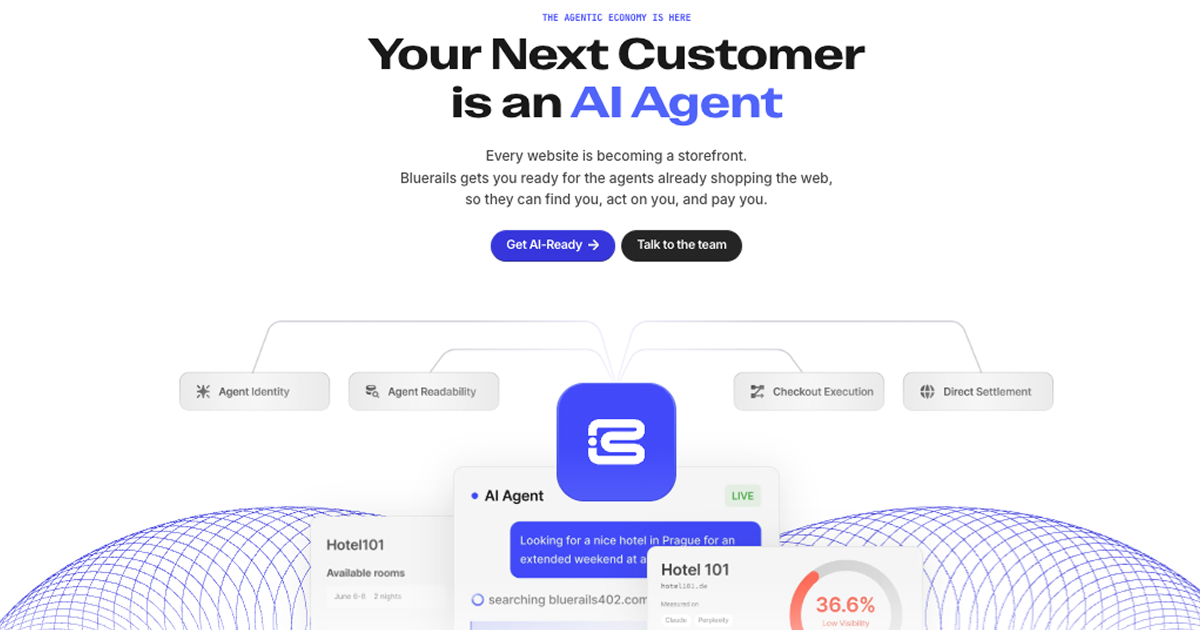
Bluerails: AI Agent Payment Infrastructure & Commerce
Bluerails provides payment infrastructure for the agentic economy, enabling AI agents to discover, act on, and pay businesses directly via agent-ready checkout and global settlement.
Site Discovery
Explore more on ToolSeekAI
Keep moving through tools, use cases, models, news, and rankings to turn one visit into a complete AI discovery path.