
GitHub - OpenHands/OpenHands: 🙌 OpenHands: AI-Driven Development
OpenHands is an open-source AI-driven development platform for building, testing, and deploying autonomous coding agents. It supports multiple LLMs via CLI/API, enabling automated code generation, DevOps, and agent orchestration without vendor lock-in.
Overview
What is OpenHands
OpenHands is an open-source AI-driven development platform designed to empower developers to build, test, and deploy AI agents and tools efficiently. Hosted on GitHub under the repository OpenHands/OpenHands, the project has garnered significant community interest, evidenced by its high star count and active contribution history. Unlike proprietary AI coding assistants that operate within closed ecosystems, OpenHands provides a flexible framework for creating autonomous software engineering agents.
The platform serves as a bridge between traditional development workflows and emerging AI capabilities. It allows users to define, manage, and execute complex AI-driven tasks through a robust Command-Line Interface (CLI) and a RESTful API. This dual-interface approach ensures that OpenHands can be seamlessly integrated into existing Continuous Integration/Continuous Deployment (CI/CD) pipelines, local development environments, or cloud-based infrastructure. By leveraging Large Language Models (LLMs) such as OpenAI’s GPT series and Anthropic’s Claude, OpenHands enables developers to harness advanced reasoning and code generation capabilities while maintaining control over the agent's behavior and output.
The core philosophy behind OpenHands is to reduce vendor lock-in and provide transparency in AI-assisted development. As an open-source tool under the MIT license, it invites community contributions and customization. This makes it particularly appealing to organizations that require strict adherence to data privacy standards or need to tailor AI agents to specific internal coding conventions and security protocols. For those interested in exploring other AI development utilities, ToolSeekAI tools offers a curated list of similar platforms, and detailed comparisons can be found in our rankings.
Key features
OpenHands distinguishes itself through a set of features designed for flexibility, extensibility, and comprehensive agent management:
- CLI and API Integration: The platform offers powerful command-line tools for quick interactions and a RESTful API for programmatic control. This allows for the automation of AI agent creation, configuration, and execution, facilitating integration into larger software ecosystems.
- Multi-Model Support: OpenHands is not tied to a single AI provider. It supports multiple large language models, including OpenAI’s GPT-4 and GPT-3.5, as well as Anthropic’s Claude. This versatility allows developers to choose the most cost-effective or performant model for specific tasks, or to switch models based on availability and pricing.
- Agent Orchestration: Beyond simple code completion, OpenHands enables the building of complex workflows involving multiple AI agents. These agents can collaborate to plan, execute, and review tasks, mimicking a team of human developers. This orchestration capability is crucial for handling multi-step software engineering projects.
- Extensible Plugin Architecture: The platform is designed to be highly extensible. Developers can add custom tools, integrations, and skills to the agents using a plugin architecture. This allows for the creation of specialized agents tailored to specific domains, such as database management, cloud infrastructure provisioning, or legacy code refactoring.
- Open-Source and Transparent: Fully open-source under the MIT license, OpenHands encourages community-driven development. Users can inspect the code, contribute improvements, and ensure that the tool aligns with their ethical and security guidelines. This transparency is a key differentiator from black-box AI solutions.
Use cases
OpenHands is versatile and can be applied to various stages of the software development lifecycle:
- Automated Code Generation and Refactoring: Agents can be tasked with writing new code modules, reviewing existing code for bugs or inefficiencies, and refactoring legacy codebases to modern standards. This accelerates development cycles and improves code quality.
- Building Chatbots and Virtual Assistants: Developers can use OpenHands to create conversational agents with advanced reasoning capabilities. These agents can handle customer support queries, provide technical assistance, or serve as internal knowledge bases.
- Data Analysis and Reporting: OpenHands agents can be configured to query databases, process large datasets, generate analytical reports, and visualize data trends. This is useful for data scientists and analysts who need to automate routine data processing tasks.
- DevOps Automation: The platform supports the automation of DevOps workflows, including CI/CD pipeline management, infrastructure monitoring, and incident response. Agents can detect anomalies, trigger alerts, and even attempt self-healing actions based on predefined policies.
For teams looking to implement these use cases, finding the right tool is essential. You can view similar platforms like OpenHands on ToolSeekAI to compare features and community support.
Pricing overview
One of the primary advantages of OpenHands is its cost structure. The platform itself is free and open-source. There are no licensing fees, subscription costs, or hidden charges for using the OpenHands software. Users can download, install, and modify the code without any financial obligation.
However, it is important to note that while the tool is free, the underlying AI models used by OpenHands are typically provided by third-party vendors. Therefore, users will incur costs associated with the API usage of the selected Large Language Model (LLM). For example, if OpenHands is configured to use OpenAI’s GPT-4 or Anthropic’s Claude, the user will pay based on the token consumption and API calls made during agent operations. These costs vary depending on the model chosen, the complexity of the tasks, and the volume of usage. Developers should monitor their API usage to manage expenses effectively. This pay-as-you-go model ensures that costs scale directly with value derived, making it accessible for individual developers and scalable for enterprise teams.
Who should use it
OpenHands is ideal for a wide range of users, including:
- Software Developers: Individuals or teams seeking to automate repetitive coding tasks, improve code quality, and accelerate development workflows without being locked into a specific vendor’s ecosystem.
- DevOps Engineers: Professionals looking to integrate AI into their CI/CD pipelines for automated testing, deployment, and monitoring. OpenHands’ extensibility allows for the creation of agents that can interact with various DevOps tools and infrastructure.
- AI Enthusiasts and Researchers: Those interested in experimenting with autonomous AI agents, multi-agent systems, and prompt engineering. The open-source nature of OpenHands provides a valuable sandbox for research and innovation.
- Enterprise Teams: Organizations that require strict control over their data and AI processes. By hosting OpenHands internally and choosing which LLMs to use, enterprises can maintain compliance with data privacy regulations and security standards.
Whether you are an individual contributor or part of a large organization, OpenHands offers the flexibility and power needed to leverage AI for software development. For more insights into AI-driven tools, explore our ToolSeekAI tools directory.
Evaluation Context and Considerations
Onboarding Flow: Setting up OpenHands requires familiarity with command-line interfaces and basic Python environments. Users must configure API keys for their chosen LLM providers. The presence of .devcontainer configurations suggests that Docker-based development environments are supported, which can simplify setup for teams using containerized workflows.
Integration Considerations: While OpenHands supports APIs, specific integration points with popular project management tools (like Jira or Linear) or version control systems (beyond GitHub) are not explicitly detailed in the source. Users may need to develop custom plugins or scripts for deep integration with non-GitHub workflows.
Data and Privacy: Since OpenHands is open-source, users can audit how data is handled. However, when sending code or prompts to external LLM providers (OpenAI, Anthropic), standard data privacy policies of those providers apply. For sensitive projects, users might consider self-hosted LLMs or private cloud instances to mitigate data leakage risks.
Pricing Verification Checklist:
- Confirm OpenHands software is free (MIT License).
- Identify the LLM provider(s) you intend to use.
- Check current API pricing for the selected LLMs (e.g., OpenAI GPT-4, Anthropic Claude).
- Estimate token usage based on expected agent activity to forecast monthly costs.
Comparison Criteria: When comparing OpenHands to other AI coding tools, consider factors such as model flexibility, ease of integration, community support, and total cost of ownership (including LLM API fees). Tools like GitHub Copilot offer a more integrated but closed experience, whereas OpenHands provides greater autonomy and customization.
FAQ
Is OpenHands completely free? Yes, the OpenHands software is free and open-source under the MIT license. There are no licensing fees.
Which AI models does OpenHands support? OpenHands supports multiple LLMs, including OpenAI’s GPT series (GPT-4, GPT-3.5) and Anthropic’s Claude. Users can configure which model to use.
Do I need to pay for the AI models? While OpenHands is free, you will incur costs for the API usage of the LLMs you choose to integrate (e.g., OpenAI or Anthropic API fees). These costs depend on your usage volume.
Can I use OpenHands for DevOps automation? Yes, OpenHands can be used to automate DevOps tasks such as CI/CD pipeline management, monitoring, and incident response through its agent orchestration capabilities.
Is OpenHands suitable for enterprise use? Yes, its open-source nature allows for customization and self-hosting, which can help enterprises meet specific security and compliance requirements. However, data sent to third-party LLM APIs is subject to those providers' policies.
How do I get started with OpenHands?
You can clone the repository from GitHub, follow the installation instructions in the documentation, and configure your LLM API keys. The project includes .devcontainer files to facilitate easy setup.
Related tools and alternatives
View all alternativesChatbots
ChatGPT
ChatGPT by OpenAI is a flagship AI assistant for drafting, reasoning, file analysis, and coding. Offering free and paid tiers with robust features, it serves individuals and enterprises seeking versatile, general-purpose AI workflows.
Chatbots
Claude
Claude by Anthropic is an advanced AI assistant specializing in long-document analysis, structured reasoning, and high-quality editorial writing. Ideal for researchers, writers, and teams needing precise, calm, and nuanced text synthesis.
Chatbots
Perplexity
Perplexity is an AI-powered search engine that combines real-time web browsing with conversational AI. It delivers cited, synthesized answers, making it ideal for researchers and knowledge workers seeking verified, source-backed information quickly.
Chatbots
Gemini
Gemini is Google's flagship multimodal AI model, deeply integrated into Workspace and Search. It offers advanced reasoning, 1M token context, and seamless productivity tools for users within the Google ecosystem.
Coding
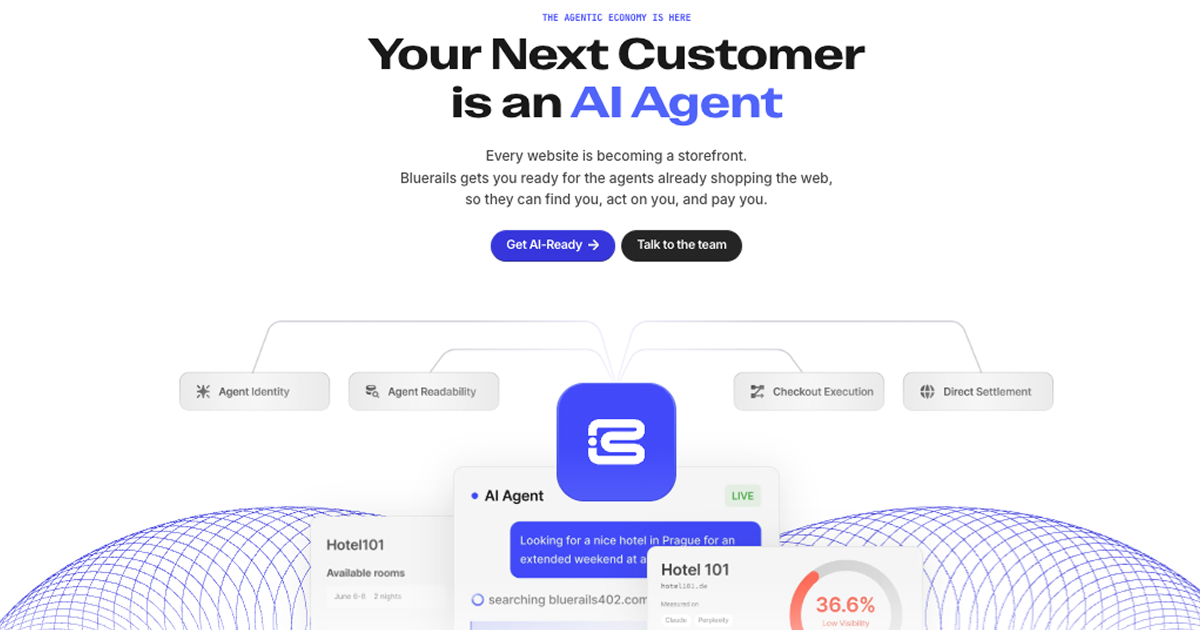
Bluerails: AI Agent Payment Infrastructure & Commerce
Bluerails provides payment infrastructure for the agentic economy, enabling AI agents to discover, act on, and pay businesses directly via agent-ready checkout and global settlement.
Chatbots
About Lumo, the privacy-first AI assistant | Lumo by Proton
Lumo by Proton is a privacy-first AI assistant offering zero-access encryption, open-source code, and GDPR compliance. It ensures conversations are never used for training or ads, available via web, iOS, and Android.
Site Discovery
Explore more on ToolSeekAI
Keep moving through tools, use cases, models, news, and rankings to turn one visit into a complete AI discovery path.