
Gemini 3.5 Flash
Gemini 3.5 Flash is a high-performance AI model designed for speed and efficiency. Explore its capabilities, use cases, and integration options for developers seeking rapid inference.
Overview
Gemini 3.5 Flash
What is Gemini 3.5 Flash?
Gemini 3.5 Flash is a large language model developed by Google, positioned within the broader Gemini family of models. As indicated by its name, "Flash" typically signifies a variant optimized for speed, latency, and cost-efficiency, making it suitable for applications requiring rapid response times. The model is accessible via Google's official channels, with announcements and technical details published on the Google Blog.
While specific architectural details beyond the naming convention are not fully elaborated in the provided source snippet, models in the "Flash" tier of AI ecosystems are generally engineered to handle high-throughput tasks, real-time interactions, and batch processing where immediate feedback is critical. It serves as a foundational tool for developers building intelligent applications that need to balance performance with resource utilization.
For developers looking to integrate advanced language models into their workflows, understanding the trade-offs between different model tiers is essential. You can explore other available options in our ToolSeekAI tools directory to compare various AI providers and model families.
Key Features
Based on the official announcement and standard characteristics of "Flash" variants in modern AI ecosystems, the key features of Gemini 3.5 Flash include:
- High-Speed Inference: Optimized for low-latency responses, enabling real-time interactions in chatbots, virtual assistants, and live data processing pipelines.
- Cost-Efficiency: Designed to reduce computational overhead per token, making it a economical choice for high-volume applications where cost-per-request is a significant factor.
- Scalability: Built to handle concurrent requests efficiently, supporting enterprise-level deployments that require robust uptime and throughput.
- Multimodal Capabilities: As part of the Gemini lineage, it likely supports multimodal inputs (text, images, etc.), allowing for versatile application development across different data types.
- Developer-Friendly Integration: Accessible through standard APIs and SDKs, facilitating easy integration into existing software stacks and cloud environments.
For a deeper dive into how these features compare to other leading models, check out our rankings of top AI language models for 2024.
Use Cases
Gemini 3.5 Flash is particularly well-suited for scenarios where speed and volume are prioritized over extreme reasoning depth. Common use cases include:
- Real-Time Chatbots and Customer Support: Handling thousands of simultaneous customer queries with minimal delay, ensuring a smooth user experience in support portals.
- Content Generation at Scale: Producing drafts, summaries, or translations for large datasets quickly, ideal for media companies or e-commerce platforms generating product descriptions.
- Code Assistance and Refactoring: Providing rapid code suggestions, completions, or basic refactoring advice in IDEs, where developers need instant feedback without waiting for complex reasoning steps.
- Data Summarization: Quickly summarizing long documents, meeting transcripts, or news articles for quick consumption by users.
- Interactive Applications: Powering games, educational tools, or creative apps that require dynamic, responsive text generation based on user input.
If you are building an interactive application, consider reviewing best practices for AI tool integration to ensure seamless performance.
Pricing Overview
Specific pricing details for Gemini 3.5 Flash are not confirmed in the source material provided. However, models in the "Flash" category are typically priced competitively to encourage high-volume usage. Pricing structures often involve:
- Pay-as-you-go: Charges based on the number of tokens processed (input and output).
- Tiered Discounts: Reduced rates for higher monthly usage volumes.
- Free Tiers: Some providers offer limited free quotas for testing and development purposes.
To verify the exact pricing for Gemini 3.5 Flash, it is recommended to visit the official Google Cloud pricing page or the announcement link provided in the source. Always check for any regional variations or enterprise-specific contracts that may affect costs.
Who Should Use It?
Gemini 3.5 Flash is ideal for:
- Startups and SMEs: Teams that need powerful AI capabilities without the high costs associated with larger, more complex models.
- Enterprise Developers: Organizations building high-throughput applications where latency directly impacts user satisfaction.
- Content Creators: Professionals who need to generate large volumes of text-based content quickly.
- Educational Institutions: Deploying AI tutors or grading assistants that require immediate feedback loops.
Before selecting a model, evaluate your team's specific needs regarding latency, accuracy, and budget. For guidance on choosing the right AI tool for your project, refer to our comprehensive guide on AI tool selection.
Onboarding Flow and Integration Considerations
Integrating Gemini 3.5 Flash typically involves the following steps:
- API Access: Obtain API keys through Google Cloud Console or Vertex AI.
- SDK Installation: Install the relevant Python or JavaScript SDKs provided by Google.
- Prompt Engineering: Design prompts optimized for the model's strengths, focusing on clarity and conciseness to leverage its speed.
- Testing: Run benchmark tests to measure latency and cost against your specific use case requirements.
- Deployment: Integrate the model into your production environment, monitoring performance metrics closely.
Ensure that your development team is familiar with prompt engineering best practices to maximize the effectiveness of the model. Resources on prompt engineering techniques can be valuable for optimizing results.
Data Privacy and Security
When using cloud-based AI models like Gemini 3.5 Flash, data privacy is a critical consideration. Key points to verify include:
- Data Retention Policies: Understand how Google handles data sent to the model. Does it store inputs for training? Can you opt-out?
- Encryption: Ensure data is encrypted in transit and at rest.
- Compliance: Verify that the service complies with relevant regulations such as GDPR, HIPAA, or CCPA, depending on your industry and location.
- Enterprise Controls: Check if there are additional security controls available for enterprise customers, such as dedicated instances or stricter data isolation.
Always review the Google Cloud Privacy Policy and the specific terms of service for Vertex AI or Gemini API before deploying sensitive data.
Pricing Verification Checklist
To accurately assess the cost of using Gemini 3.5 Flash, consider the following checklist:
- Confirm the current price per 1 million tokens for input and output.
- Check for any minimum commitment requirements.
- Verify if there are discounts for sustained use or reserved capacity.
- Determine if there are additional costs for premium support or SLAs.
- Compare the total cost of ownership (TCO) against alternative models like Gemini Pro or other competitors.
Comparison Criteria
When comparing Gemini 3.5 Flash to other models, evaluate:
- Latency: How fast does it respond under load?
- Throughput: How many requests can it handle simultaneously?
- Accuracy: Is the quality of output sufficient for your use case, even if it sacrifices some depth?
- Cost: What is the price per useful output?
- Ecosystem: How well does it integrate with your existing tech stack?
By systematically evaluating these factors, you can determine if Gemini 3.5 Flash is the right fit for your AI-driven projects. For more detailed comparisons, browse our AI model comparison tools.
Why it stands out
- Optimized for high-speed, low-latency responses
- Cost-effective for high-volume usage
- Suitable for real-time interactive applications
- Part of the robust Gemini ecosystem
- Scalable for enterprise-level deployments
Watch before using
- Specific pricing details not confirmed in source
- May sacrifice deep reasoning for speed
- Requires careful prompt engineering for optimal results
- Data privacy policies must be verified individually
- Limited detailed architectural info in source snippet
FAQ
What is Gemini 3.5 Flash?
Who should use Gemini 3.5 Flash?
How does Gemini 3.5 Flash compare to other models?
Is data privacy supported?
Where can I find pricing information?
What are common use cases?
Related tools and alternatives
View all alternativesCoding
Cursor
Cursor is an AI-native code editor that embeds deep repository awareness into the development workflow, enabling multi-file refactoring, code generation, and debugging without context switching.
Coding
Replit
Replit is a browser-based IDE with built-in AI coding assistants, real-time collaboration, and one-click deployment. Ideal for rapid prototyping, education, and AI agent development without local setup.
Coding
GitHub Copilot
GitHub Copilot is an AI-powered pair programmer that suggests code, debugs, and automates tasks across multiple languages and IDEs, integrating deeply with GitHub workflows for individuals, teams, and enterprises.
Coding
Google Antigravity 2.0
Google Antigravity 2.0 is a playful April Fools' joke from Google Developers. It is not a real software tool, API, or developer resource, but rather a humorous web experience.
Coding
Gemma 4
Gemma 4 is Google's latest open-weight large language model series, designed for advanced reasoning, coding, and multimodal tasks with optimized efficiency for enterprise and developer deployment.
Coding
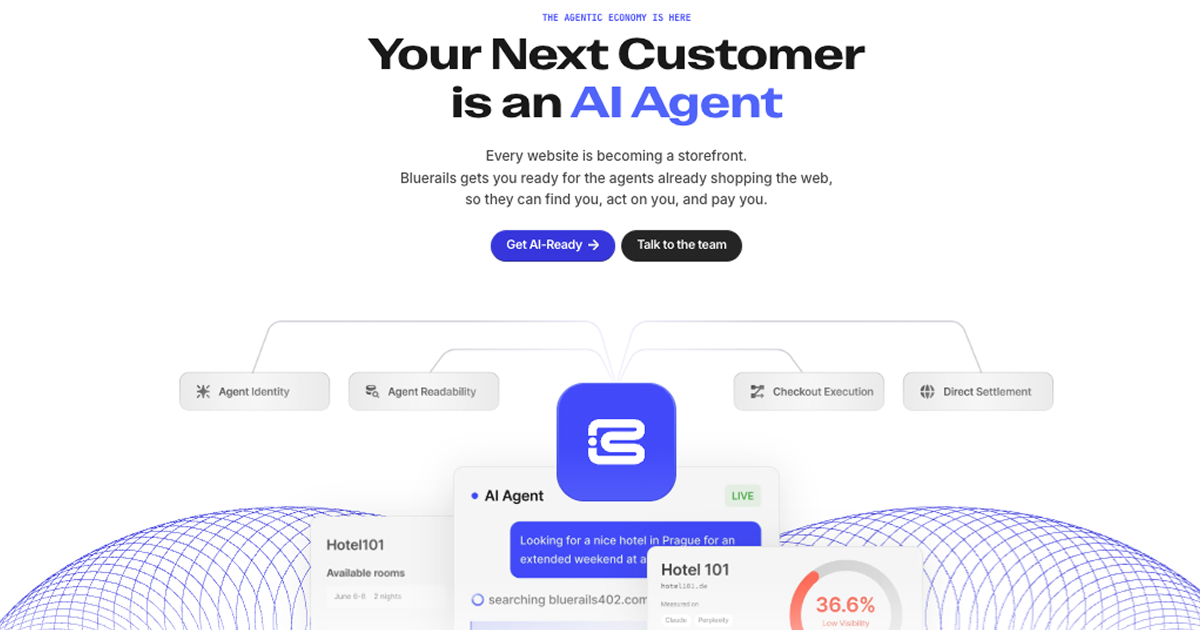
Bluerails: AI Agent Payment Infrastructure & Commerce
Bluerails provides payment infrastructure for the agentic economy, enabling AI agents to discover, act on, and pay businesses directly via agent-ready checkout and global settlement.
Site Discovery
Explore more on ToolSeekAI
Keep moving through tools, use cases, models, news, and rankings to turn one visit into a complete AI discovery path.