

Enterprise AI: Private, Secure, Customizable | Cohere
Cohere offers enterprise-grade AI solutions focused on privacy, security, and customization. It provides models for search, generation, and coding, allowing businesses to deploy private infrastructure and keep their data secure.
Overview
Cohere: Enterprise AI for Private, Secure, and Customizable Workflows
Cohere positions itself as a leader in enterprise artificial intelligence, emphasizing a core philosophy of "Own your AI." The platform is designed to help organizations automate processes, empower employees, and transform fragmented data into actionable insights while maintaining strict control over their data and infrastructure. Unlike many public-facing AI services, Cohere’s primary value proposition lies in its ability to offer private deployments and customizable models tailored to specific business needs.
What is Cohere?
Cohere is an AI company that builds powerful large language models (LLMs) and AI solutions specifically for enterprise use. The platform provides a suite of products ranging from generative models to advanced retrieval systems, all aimed at integrating AI into modern workplace productivity. The official description highlights that Cohere enables enterprises to automate processes and turn data into insights without compromising security.
The platform is structured around several key pillars:
- Generative Models: For creating text, code, and understanding multimodal inputs.
- Advanced Retrieval: For enhancing search accuracy and semantic understanding.
- Security & Privacy: Through private deployments and dedicated inference platforms like Model Vault.
- Customization: Allowing businesses to fine-tune models on their proprietary data.
For more details on how Cohere compares to other enterprise AI providers, you can explore our rankings of top AI tools for business.
Key Features
Cohere’s product suite is comprehensive, targeting various aspects of enterprise AI implementation. The following features are derived directly from the official website metadata and homepage excerpts.
Generative Models
- Command: Described as high-performance models for agentic, multimodal, and multilingual AI. This is likely the core engine for general-purpose text generation and reasoning tasks.
- North Mini Code: Cohere’s first model specifically for developers, built for practical software engineering tasks. It is designed to assist in coding workflows.
- Transcribe: A speech recognition model aimed at generating highly accurate audio transcripts, facilitating voice-to-text automation.
Advanced Retrieval and Search
- Embed: A leading multimodal search and retrieval tool. This model helps convert data into vector representations for efficient searching.
- Rerank: A powerful model that provides a semantic boost to search quality, ensuring that retrieved results are highly relevant to the query.
- Compass: An intelligent search and discovery system designed to surface business insights. It leverages the underlying retrieval models to help employees find information within their organization.
Workplace Productivity
- North: An enterprise-ready AI platform that powers modern workplace productivity. This appears to be a broader solution or interface that integrates various AI capabilities into daily workflows.
Security and Infrastructure
- Model Vault: A dedicated, secure model inference platform managed by Cohere. This ensures that model execution happens in a controlled environment.
- Private Deployments: A critical feature for enterprises concerned with data sovereignty. Cohere allows businesses to deploy models in their own infrastructure, ensuring that sensitive data never leaves their control.
- Cohere Labs: The research arm of the company, seeking to solve complex machine learning problems, which informs the continuous improvement of their models.
Use Cases
Cohere’s solutions are applicable across a wide range of industries and functional areas. The official site lists several target sectors, indicating the versatility of their platform.
Industry Applications
- Financial Services: For compliance, risk analysis, and customer service automation.
- Healthcare and Life Sciences: For managing patient data securely and assisting in research.
- Manufacturing: For optimizing supply chains and technical documentation.
- Energy and Utilities: For operational efficiency and data management.
- Public Sector: For secure citizen services and administrative automation.
- Telecommunications: For network optimization and customer support.
Functional Use Cases
- Intelligent Search: Using Compass and Rerank to help employees find relevant documents and insights quickly within vast corporate databases.
- Code Generation and Assistance: Utilizing North Mini Code to accelerate software development lifecycles.
- Audio Transcription: Leveraging Transcribe to convert meeting recordings or customer calls into searchable text.
- Data Insights: Turning fragmented internal data into structured, actionable intelligence using Embed and generative models.
Pricing Overview
The source material indicates that Cohere offers a "Pricing Models Overview" page, but specific dollar amounts or tier structures are not detailed in the provided excerpts. The emphasis is on enterprise solutions, which typically involve custom quoting based on deployment scale, model usage, and infrastructure requirements.
To understand the cost structure, users are directed to contact sales or explore the pricing overview. It is important to note that for private deployments and dedicated inference platforms like Model Vault, pricing is likely customized. For those interested in comparing cost-efficiency across different AI vendors, you can view our list of AI tools for enterprise budgeting.
Who Should Use It?
Cohere is primarily designed for enterprises and large organizations that have specific requirements for:
- Data Privacy and Security: Companies in regulated industries (finance, healthcare, public sector) that cannot use public AI APIs due to data sensitivity. The option for private deployments is a key differentiator.
- Customization Needs: Organizations that need models fine-tuned on their proprietary data to achieve high accuracy in domain-specific tasks.
- Scalability: Businesses looking for robust, high-performance models (Command) that can handle large-scale operations.
- Developer Integration: Software engineering teams that require specialized coding assistance (North Mini Code) and reliable API access.
Evaluation Context and Considerations
When evaluating Cohere for enterprise adoption, consider the following factors grounded in the source material:
- Onboarding Flow: The source mentions "Developers Docs" and "Cookbooks," suggesting a strong focus on technical integration. Teams will likely need to engage with these resources to implement models like Embed and Command effectively.
- Integration Considerations: The platform offers both standalone models (like Transcribe) and integrated systems (like North and Compass). Enterprises should assess whether they need a full workplace productivity suite or modular API access for existing systems.
- Data/Privacy Questions: The explicit mention of "Private Deployments" and "Model Vault" addresses major data governance concerns. However, specific data retention policies or compliance certifications (e.g., SOC2, HIPAA) are not confirmed in the provided source text and should be verified during the sales process.
- Comparison Criteria: When comparing Cohere to other AI providers, key criteria include the performance of Command vs. competitors' LLMs, the accuracy of Rerank in search contexts, and the flexibility of private deployment options.
Pros
- Strong Focus on Security: Offers private deployments and dedicated inference platforms, addressing critical enterprise data privacy concerns.
- Comprehensive Product Suite: Provides end-to-end solutions including generative models, retrieval tools, and workplace systems like Compass.
- Developer-Centric Tools: Includes specialized models like North Mini Code for software engineering workflows.
- Industry-Specific Solutions: Tailored offerings for regulated sectors such as finance, healthcare, and public sector.
- Actionable Insights: Tools like Compass and Rerank are designed to turn fragmented data into clear business insights.
Cons
- Pricing Not Publicly Listed: Specific costs are not available in the source material, requiring direct contact with sales for quotes, which may complicate budget planning.
- Complexity for Small Teams: The enterprise-focused nature and private deployment options may be overkill or too complex for small startups or individual developers.
- Limited Detail on Compliance: While security is highlighted, specific regulatory compliance certifications are not confirmed in the provided text.
- Dependency on Integration: Maximizing value requires integrating multiple tools (Embed, Rerank, Command), which may demand significant engineering resources.
- Niche Model Availability: Some models like North Mini Code are described as "NEW," suggesting they may still be maturing compared to established legacy tools.
For further exploration of Cohere’s capabilities and customer stories, visit the Customer Stories section or review their Resources for technical documentation.
Related tools and alternatives
View all alternativesCoding
Cursor
Cursor is an AI-native code editor that embeds deep repository awareness into the development workflow, enabling multi-file refactoring, code generation, and debugging without context switching.
Coding
Replit
Replit is a browser-based IDE with built-in AI coding assistants, real-time collaboration, and one-click deployment. Ideal for rapid prototyping, education, and AI agent development without local setup.
Coding
GitHub Copilot
GitHub Copilot is an AI-powered pair programmer that suggests code, debugs, and automates tasks across multiple languages and IDEs, integrating deeply with GitHub workflows for individuals, teams, and enterprises.
Coding
Google Antigravity 2.0
Google Antigravity 2.0 is a playful April Fools' joke from Google Developers. It is not a real software tool, API, or developer resource, but rather a humorous web experience.
Coding
Gemma 4
Gemma 4 is Google's latest open-weight large language model series, designed for advanced reasoning, coding, and multimodal tasks with optimized efficiency for enterprise and developer deployment.
Coding
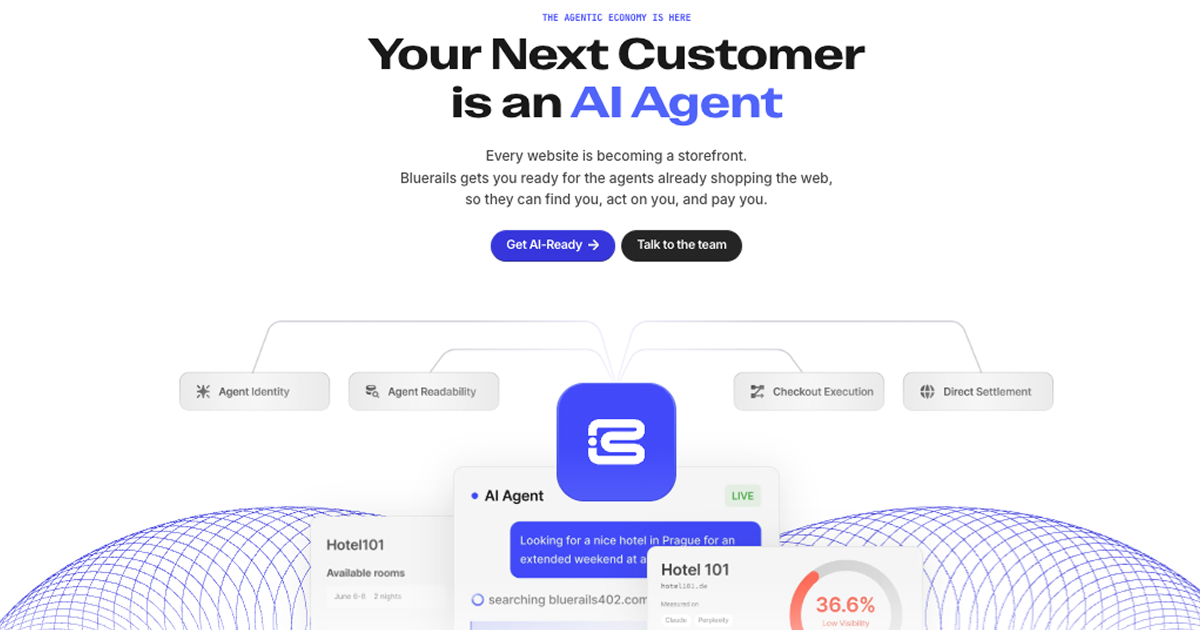
Bluerails: AI Agent Payment Infrastructure & Commerce
Bluerails provides payment infrastructure for the agentic economy, enabling AI agents to discover, act on, and pay businesses directly via agent-ready checkout and global settlement.
Site Discovery
Explore more on ToolSeekAI
Keep moving through tools, use cases, models, news, and rankings to turn one visit into a complete AI discovery path.