
Gemma 4 12B
Gemma 4 12B is Google's latest open-weight model announced at I/O 2026. It offers a lightweight, efficient architecture optimized for both on-device deployment and cloud inference, balancing performance with resource constraints.
Overview
What is Gemma 4 12B
Gemma 4 12B is an open-weight large language model developed by Google DeepMind. Announced during the Google I/O 2026 conference, this iteration represents a significant step in Google's strategy to democratize access to high-performance AI models while maintaining strict efficiency standards. The "12B" designation refers to its parameter count, positioning it as a mid-sized model that bridges the gap between smaller, ultra-lightweight models and larger, computationally expensive flagship models.
As part of the ongoing Gemma series, this model is designed to be accessible to developers, researchers, and enterprises who require robust natural language processing capabilities without the overhead associated with multi-hundred-billion parameter models. The model is available for download and integration via ToolSeekAI tools, allowing users to explore its capabilities within various development environments.
The core philosophy behind Gemma 4 12B is efficiency. Google has optimized the architecture to deliver strong performance metrics relative to its size, making it particularly suitable for scenarios where latency, cost, or hardware constraints are critical factors. Whether deployed on edge devices or scaled across cloud infrastructure, the model aims to provide a reliable and responsive AI experience.
Key Features
Optimized Efficiency
The primary feature of Gemma 4 12B is its lightweight nature. With 12 billion parameters, it requires significantly less memory and computational power compared to larger models. This efficiency translates to faster inference times and lower operational costs, especially when running on limited hardware resources.
Dual Deployment Modes
Gemma 4 12B is engineered for versatility in deployment. It supports both on-device and cloud-based inference. On-device deployment allows for offline functionality, enhanced privacy, and reduced latency for end-users. Cloud deployment enables scalable processing for complex tasks and integration into larger enterprise workflows.
Open-Weight Accessibility
Following the tradition of previous Gemma releases, this model is open-weight. This means that while the weights are publicly available for research and commercial use under specific licensing terms, the underlying training data and full training methodology may not be entirely public. This openness encourages innovation and allows developers to fine-tune the model for specific domains.
Advanced Reasoning Capabilities
Despite its smaller size, Gemma 4 12B incorporates architectural improvements aimed at enhancing reasoning, coding, and instruction-following abilities. These enhancements ensure that the model remains competitive in benchmark tests against other models of similar size, providing high-quality outputs for a wide range of tasks.
Integration with Google Ecosystem
As a Google-developed model, Gemma 4 12B is designed to integrate seamlessly with existing Google Cloud services and tools. This includes compatibility with Vertex AI, TensorFlow, and other popular machine learning frameworks, facilitating easy adoption for teams already invested in the Google ecosystem.
Use Cases
Edge AI Applications
Due to its efficiency, Gemma 4 12B is ideal for edge computing applications. Developers can deploy the model on smartphones, IoT devices, or embedded systems to enable local AI processing. This is particularly useful for applications requiring real-time response, such as voice assistants, smart home devices, or mobile productivity tools, where sending data to the cloud is impractical or raises privacy concerns.
Cost-Effective Cloud Inference
For businesses looking to reduce AI infrastructure costs, Gemma 4 12B offers a compelling alternative to larger models. By running the model in the cloud, organizations can handle high volumes of requests with lower compute costs. This makes it suitable for customer support chatbots, content generation pipelines, and data analysis tasks that do not require the extreme reasoning capabilities of larger models.
Fine-Tuning for Specific Domains
The open-weight nature of the model allows for fine-tuning on proprietary datasets. Industries such as healthcare, finance, or legal services can adapt the model to understand domain-specific terminology and workflows. This customization ensures higher accuracy and relevance in specialized applications, leveraging the base model's strong foundational knowledge.
Prototyping and Research
Researchers and developers can use Gemma 4 12B as a baseline for experiments. Its manageable size allows for rapid iteration and testing of new algorithms or prompt engineering techniques without the prohibitive costs associated with larger models. This accessibility fosters innovation and accelerates the development cycle for new AI applications.
Pricing Overview
The pricing structure for Gemma 4 12B depends on the deployment method:
- Self-Hosted/Open Weights: The model weights are available for free download under Google's Gemma license. Users are responsible for their own infrastructure costs, whether on-premise or via cloud providers. This option offers maximum flexibility but requires technical expertise to manage deployment and scaling.
- Google Cloud Vertex AI: For users preferring a managed service, the model is available through Google Cloud Vertex AI. Pricing is based on usage metrics such as tokens processed or compute time. This option reduces operational overhead but may incur higher per-unit costs compared to self-hosting at scale.
- Third-Party Platforms: The model may also be accessible through various AI platforms and marketplaces listed on ToolSeekAI rankings. Pricing varies by provider, often including additional features like API access, monitoring, and support.
It is important to note that specific pricing details for Google Cloud hosting are not confirmed in the source and should be verified directly with Google Cloud or the respective provider. Users should perform a pricing verification checklist to compare self-hosting costs against managed service fees based on their expected workload.
Who Should Use It
Small to Medium Enterprises (SMEs)
SMEs with limited IT budgets can benefit from the cost-efficiency of Gemma 4 12B. The ability to run the model on modest hardware or pay only for what they use in the cloud makes advanced AI accessible without significant capital investment.
Mobile and IoT Developers
Developers creating applications for resource-constrained devices will find Gemma 4 12B's on-device optimization valuable. It enables sophisticated AI features in apps where connectivity is intermittent or privacy is paramount.
AI Researchers and Academics
Researchers looking to experiment with mid-sized models can utilize Gemma 4 12B for studies on model efficiency, fine-tuning techniques, and comparative analysis. The open-weight license facilitates academic collaboration and publication.
Enterprise Teams Seeking Scalability
Large organizations can use the model for high-volume, lower-complexity tasks such as document summarization, basic code assistance, or routine data classification. Its scalability in the cloud allows enterprises to handle fluctuating demand efficiently.
For those interested in exploring more options, you can browse additional models on ToolSeekAI tools to compare features and suitability for your specific needs.
Evaluation Context
Onboarding Flow
Onboarding for Gemma 4 12B involves downloading the model weights from the official repository and setting up the necessary inference environment. For cloud users, integration with Vertex AI simplifies this process through pre-configured endpoints. Detailed documentation is provided to guide users through setup, though specific API keys and configuration steps are not confirmed in the source.
Suitable Teams
Teams with moderate AI expertise are best suited for this model. While the open-weight nature allows for deep customization, it also requires understanding of model deployment, quantization, and optimization techniques. Teams lacking these skills may prefer managed services.
Integration Considerations
Integration with existing ML pipelines should be straightforward due to compatibility with standard frameworks like TensorFlow and PyTorch. However, users should consider the computational requirements of their hardware if choosing self-hosting. Network latency is a key factor for cloud deployments, which should be evaluated based on geographic distribution of users.
Data and Privacy Questions
Using the model locally enhances data privacy as sensitive information does not leave the device. When using cloud services, users must review the data handling policies of the provider. Google typically offers enterprise-grade security and compliance features, but specific data retention policies for Gemma 4 12B are not confirmed in the source and should be verified with Google Cloud.
Comparison Criteria
When comparing Gemma 4 12B to other models, consider parameter count, inference speed, memory footprint, and benchmark performance on tasks like reasoning, coding, and language understanding. Its position in the mid-size category makes it a strong contender against other 7B-13B parameter models from competitors.
Pros
- Lightweight and efficient for on-device and cloud use.
- Open-weight license promotes flexibility and customization.
- Strong balance between performance and resource consumption.
- Seamless integration with Google Cloud and Vertex AI.
- Suitable for a wide range of applications from edge to enterprise.
Cons
- May lack the depth of reasoning found in larger, more complex models.
- Self-hosting requires technical expertise in model deployment.
- Specific pricing for cloud services is not detailed in the source.
- Licensing terms for commercial use need careful review.
- Performance benchmarks against non-Google models are not explicitly confirmed in the source.
Related tools and alternatives
View all alternativesCoding
Cursor
Cursor is an AI-native code editor that embeds deep repository awareness into the development workflow, enabling multi-file refactoring, code generation, and debugging without context switching.
Coding
Replit
Replit is a browser-based IDE with built-in AI coding assistants, real-time collaboration, and one-click deployment. Ideal for rapid prototyping, education, and AI agent development without local setup.
Coding
GitHub Copilot
GitHub Copilot is an AI-powered pair programmer that suggests code, debugs, and automates tasks across multiple languages and IDEs, integrating deeply with GitHub workflows for individuals, teams, and enterprises.
Coding
Google Antigravity 2.0
Google Antigravity 2.0 is a playful April Fools' joke from Google Developers. It is not a real software tool, API, or developer resource, but rather a humorous web experience.
Coding
Gemma 4
Gemma 4 is Google's latest open-weight large language model series, designed for advanced reasoning, coding, and multimodal tasks with optimized efficiency for enterprise and developer deployment.
Coding
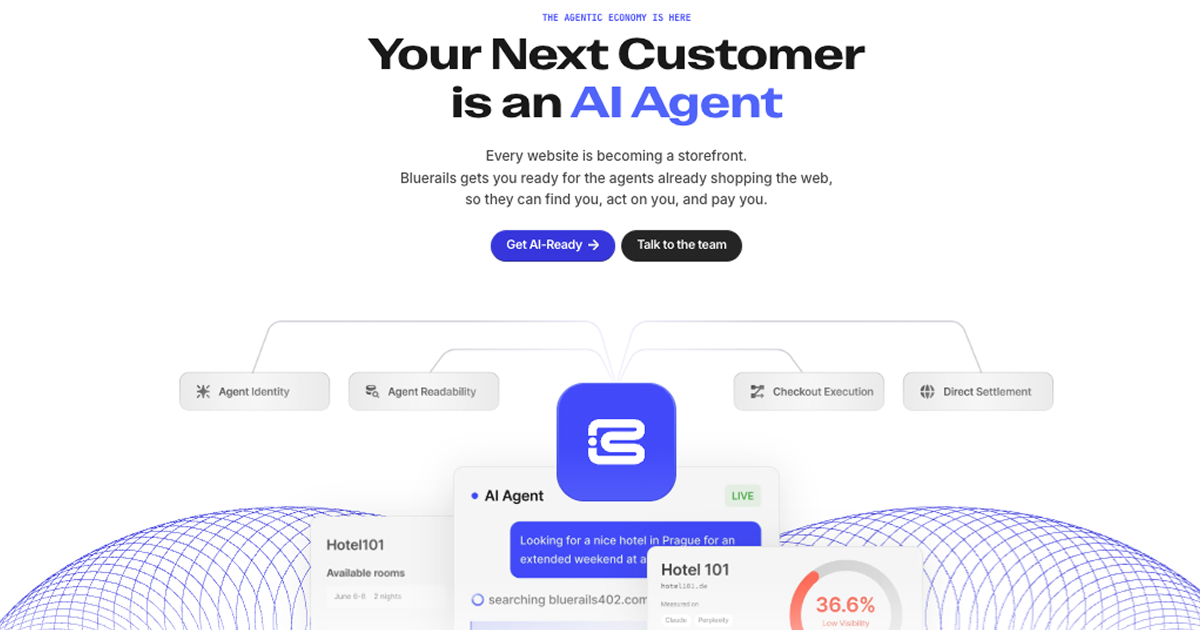
Bluerails: AI Agent Payment Infrastructure & Commerce
Bluerails provides payment infrastructure for the agentic economy, enabling AI agents to discover, act on, and pay businesses directly via agent-ready checkout and global settlement.
Site Discovery
Explore more on ToolSeekAI
Keep moving through tools, use cases, models, news, and rankings to turn one visit into a complete AI discovery path.