
Ask an AI expert: What exactly is the full stack?
Google AI experts define 'full-stack' AI as the end-to-end integration of hardware, software, and models, positioning it as the foundational strategy for building robust and scalable artificial intelligence systems.

Signal Snapshot
Briefing Notes
What happened and why it matters
Summary
Google AI experts have recently articulated a comprehensive definition of "full-stack" artificial intelligence. In their analysis, they describe full-stack AI not merely as a software layer, but as the end-to-end integration of three core components: hardware, software, and models. This holistic approach is presented as the foundational strategy required to build artificial intelligence systems that are both robust and scalable. By emphasizing the interdependence of these physical and digital layers, Google highlights a shift toward viewing AI development as a unified engineering discipline rather than isolated tasks.
Why it matters
The concept of full-stack AI addresses the growing complexity of deploying large-scale machine learning solutions. Historically, many organizations treated model development, software engineering, and infrastructure management as separate silos. However, as AI models grow larger and more demanding, the performance bottlenecks often occur at the intersection of these domains. For instance, a state-of-the-art model may underperform if the underlying hardware cannot support its inference requirements, or if the software stack lacks the necessary optimization layers.
By defining full-stack AI as the integration of these elements, Google provides a framework for engineers and architects to prioritize compatibility and efficiency across the entire pipeline. This perspective is crucial for companies aiming to reduce latency, lower computational costs, and ensure reliability in production environments. It suggests that future advancements in AI will depend less on incremental improvements to algorithms alone and more on the synergistic optimization of the entire technology stack.
Related tools
For developers looking to implement these principles, exploring specialized resources is essential. You can browse the latest AI tools designed to streamline integration workflows. Additionally, accessing the model library allows you to find pre-trained weights and APIs that are optimized for various hardware configurations. Finally, checking the rankings can help identify which tools and models are currently leading in terms of performance and scalability metrics.
Impact on AI tools/models
This definition influences how new tools and models are evaluated. Instead of focusing solely on benchmark scores, developers must consider how well a model interacts with specific hardware architectures and software frameworks. This leads to a demand for tools that offer better visibility into resource utilization and cross-layer optimization. Models that are designed with hardware constraints in mind from the outset are likely to gain traction, as they promise easier deployment and better real-world performance. Consequently, the industry may see a rise in integrated platforms that bundle hardware recommendations, software drivers, and model weights together, simplifying the path from prototype to production.
What to watch
As the industry moves toward this integrated model, several key areas require attention. First, monitor developments in hardware-software co-design, where processors are increasingly tailored to specific AI workloads. Second, keep an eye on open-source initiatives that aim to standardize interfaces between different layers of the stack, facilitating easier swapping of components. Third, watch for new evaluation metrics that assess the efficiency of the full stack, rather than just the accuracy of individual models. For ongoing updates on these trends, visit our AI news section. Developers interested in practical implementations should regularly check ToolSeekAI tools for emerging solutions. Furthermore, staying informed through rankings will help identify which full-stack approaches are proving most effective in real-world scenarios.
FAQ
What is full-stack AI according to Google? Google defines full-stack AI as the end-to-end integration of hardware, software, and models to create robust and scalable systems.
Why is integration important in AI development? Integration ensures that models perform efficiently on available hardware and within existing software frameworks, reducing bottlenecks and improving reliability.
Where can I find tools related to full-stack AI? You can explore relevant resources by browsing AI tools and checking the model library for compatible weights and APIs.
Search FAQ
Frequently asked questions
FAQ
What is full-stack AI according to Google?
Why is full-stack AI considered important?
Keep Tracking
Related AI news

Create, edit and star in videos with two Google Vids updates
Google Vids integrates Gemini Omni for enhanced video generation and introduces personal avatars, allowing users to create, edit, and star in customized AI-generated video content.
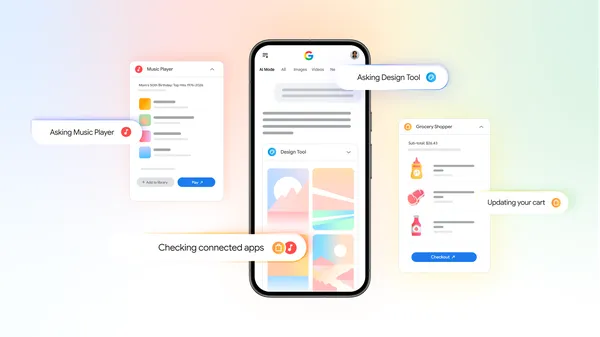
Connect more of your apps to Search
Google AI introduces a new feature in AI Mode that allows users to securely connect and interact with third-party applications directly within the interface, aiming to enhance productivity and deep integration.

Expanding Managed Agents in Gemini API: background tasks, remote MCP and more
Google AI expands Gemini API Managed Agents with background task execution and remote MCP support, enabling developers to deploy reliable, production-ready autonomous workflows.

Gemini 3.5: frontier intelligence with action
Google unveils Gemini 3.5 at Google I/O, shifting focus from passive reasoning to active execution. Designed to perform complex tasks directly, marking a significant evolution in actionable AI capabilities.

New York City educators and industry leaders gathered at Google’s offices to shape the future of AI in classrooms.
Google hosted an AI summit in NYC with 150 education and industry leaders to discuss integrating AI into classrooms, focusing on practical applications for educators.

The latest AI news we announced in June 2026
Google AI released updates in June 2026, though specific details on new models or features were not included in the provided source text.
Site Discovery
Keep exploring the AI ecosystem
After this brief, continue into related tools, models, and rankings to understand whether the story affects your choices.