
Expanding Managed Agents in Gemini API: background tasks, remote MCP and more
Google AI expands Gemini API Managed Agents with background task execution and remote MCP support, enabling developers to deploy reliable, production-ready autonomous workflows.
Signal Snapshot
Briefing Notes
What happened and why it matters
Summary
Google AI has announced an expansion of its Managed Agents capabilities within the Gemini API. The update introduces support for background task execution and remote Model Context Protocol (MCP) integration. These enhancements are explicitly designed to help developers construct reliable, production-ready autonomous agent workflows.
Why it matters
The shift toward managed agents marks a significant step in operationalizing large language models beyond simple chat interfaces. By offloading long-running operations to background tasks, developers can prevent timeout errors and maintain state across complex multi-step processes. Remote MCP support further bridges the gap between isolated model environments and external data sources or toolchains. This architectural improvement reduces the engineering overhead typically required to stabilize agent deployments, allowing teams to focus on logic and user experience rather than infrastructure plumbing. As autonomous systems become standard in enterprise software, standardized managed execution layers will likely dictate which frameworks scale efficiently in real-world conditions.
Related tools
Developers building on this foundation may explore existing agent orchestration frameworks and protocol implementations. Relevant resources include Agent SDKs, MCP Clients, and Workflow Automators. These categories align closely with the new background execution and remote connectivity features highlighted in the announcement.
Impact on AI tools/models
The introduction of managed background processing directly influences how models handle asynchronous workloads. Instead of forcing synchronous request-response cycles, the Gemini API now accommodates deferred execution patterns common in data processing, research aggregation, and automated testing pipelines. Remote MCP compatibility also encourages a more modular ecosystem where models can dynamically fetch context from third-party services without hardcoding integrations. This pushes the broader AI tooling landscape toward standardized, interoperable agent architectures that prioritize reliability over raw inference speed.
What to watch
As these managed agent capabilities roll out, the developer community will likely monitor adoption rates across different deployment environments. Tracking how remote MCP implementations handle security boundaries and latency will be crucial for enterprise trust. Additionally, observing how third-party platforms adapt their own agent frameworks to complement or compete with this new execution model will shape the next generation of AI infrastructure. For ongoing updates on framework releases and benchmark comparisons, visit ToolSeekAI tools, AI news, and rankings.
FAQ
No additional frequently asked questions are available based on the current announcement details.
Keep Tracking
Related AI news

Create, edit and star in videos with two Google Vids updates
Google Vids integrates Gemini Omni for enhanced video generation and introduces personal avatars, allowing users to create, edit, and star in customized AI-generated video content.
Connect more of your apps to Search
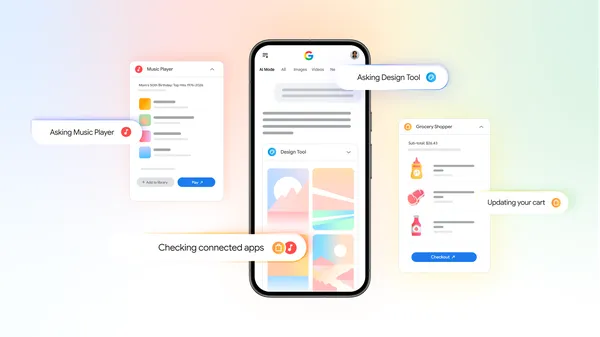
Google AI introduces a new feature in AI Mode that allows users to securely connect and interact with third-party applications directly within the interface, aiming to enhance productivity and deep integration.

Gemini 3.5: frontier intelligence with action
Google unveils Gemini 3.5 at Google I/O, shifting focus from passive reasoning to active execution. Designed to perform complex tasks directly, marking a significant evolution in actionable AI capabilities.

New York City educators and industry leaders gathered at Google’s offices to shape the future of AI in classrooms.
Google hosted an AI summit in NYC with 150 education and industry leaders to discuss integrating AI into classrooms, focusing on practical applications for educators.

The latest AI news we announced in June 2026
Google AI released updates in June 2026, though specific details on new models or features were not included in the provided source text.

Unlocking Britain’s next era of productivity: Building a nation of AI trailblazers
Google UK's new Economic Impact Report outlines strategies to boost national productivity via AI adoption, aiming to position Britain as a global leader in the AI era.
Site Discovery
Keep exploring the AI ecosystem
After this brief, continue into related tools, models, and rankings to understand whether the story affects your choices.