
Decision Comparison
BrowserAct | Give AI agent the power to use the web vs Enterprise AI: Private, Secure, Customizable | Cohere
Compare BrowserAct, a specialized tool for giving AI agents managed browser access and CAPTCHA handling, with Cohere, an enterprise-grade provider of private, secure, and customizable Large Language Models.
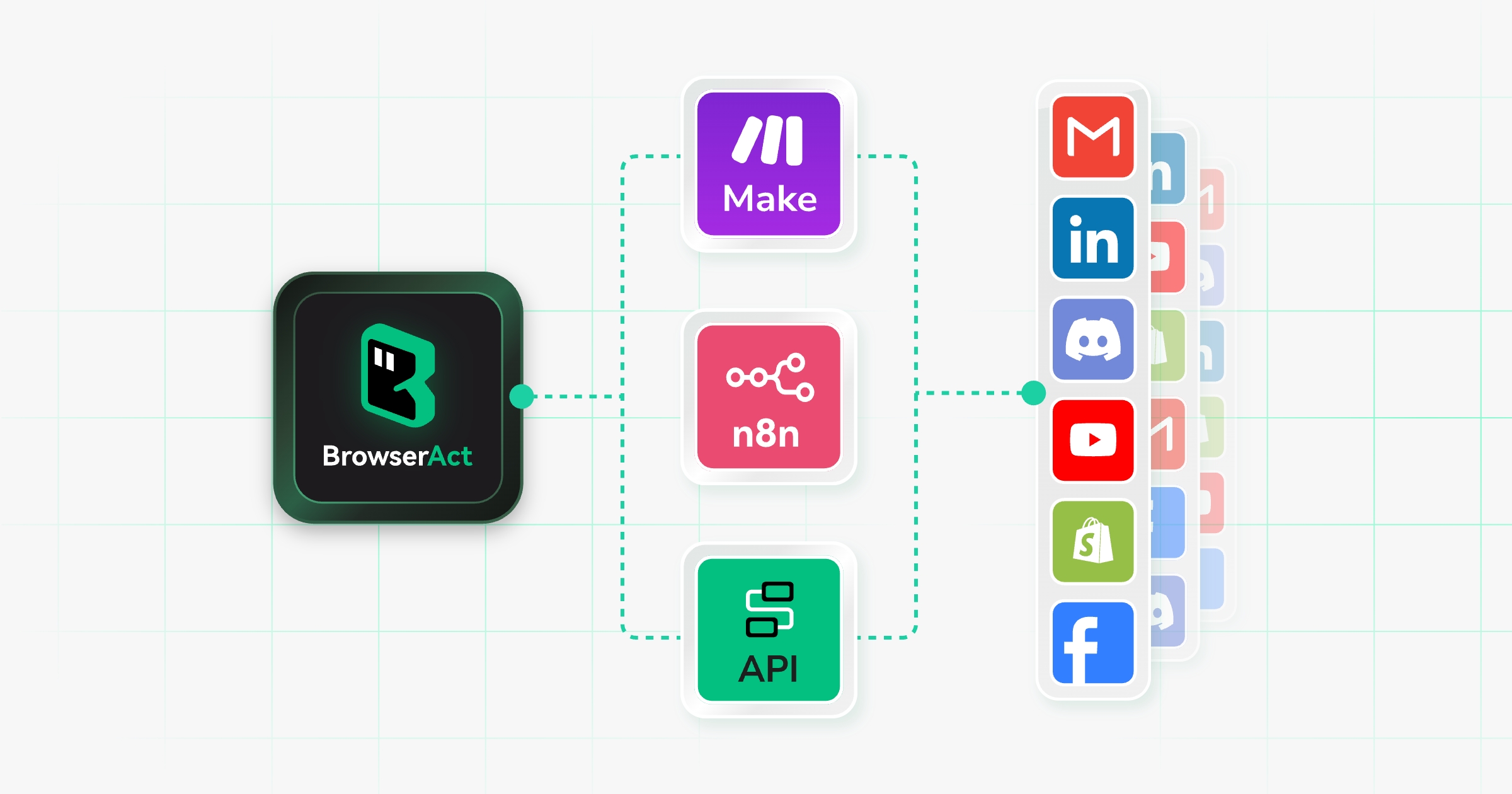
BrowserAct | Give AI agent the power to use the web
BrowserAct provides AI agents with a managed browser layer to extract live web data, handle CAPTCHAs, and execute end-to-end web tasks securely.
- Pricing
- Not listed
- Free tier
- Not listed
Pros
- Handles CAPTCHAs and anti-bot measures automatically.
- Offers a 7-day free trial with 100 credits.
- Supports multiple proxy types including residential and static.
- Integrates easily via skills for AI agents.
- Provides full session and cookie isolation.
Cons
- Cloud Browser feature is not yet released.
- Pricing is credit-based, which may vary in complexity.
- Requires technical integration for agent workflows.
- Static proxy pricing varies by location and tier.
- No specific enterprise SLA details provided in source.

Enterprise AI: Private, Secure, Customizable | Cohere
Cohere offers enterprise-grade AI solutions focused on privacy, security, and customization. It provides models for search, generation, and coding, allowing businesses to deploy private infrastructure and keep their data secure.
- Pricing
- Not listed
- Free tier
- Not listed
Side-by-side signals
Core comparison table
| Signal | BrowserAct | Give AI agent the power to use the web | Enterprise AI: Private, Secure, Customizable | Cohere |
|---|---|---|
| Summary | BrowserAct provides AI agents with a managed browser layer to extract live web data, handle CAPTCHAs, and execute end-to-end web tasks securely. | Cohere offers enterprise-grade AI solutions focused on privacy, security, and customization. It provides models for search, generation, and coding, allowing businesses to deploy private infrastructure and keep their data secure. |
| Pricing | Not listed | Not listed |
| Free tier | Not listed | Not listed |
| Pros count | 5 | 0 |
| Cons count | 5 | 0 |
Comparison analysis
## Overview
When building AI-driven applications, selecting the right infrastructure depends heavily on whether you need to interact with the live web or process internal data. **BrowserAct** and **Cohere** serve distinct but complementary roles in the modern AI stack. BrowserAct focuses on the 'hands' of the AI agent—providing a managed browser layer to navigate websites, bypass anti-bot measures, and extract real-time data. In contrast, Cohere focuses on the 'brain'—offering enterprise-grade Large Language Models (LLMs) optimized for privacy, security, and customization, allowing businesses to deploy private inference engines.
## Core Capabilities Comparison
### BrowserAct: Agentic Web Interaction
BrowserAct is designed specifically for Autonomous Agents that require reliable access to the live internet. Its primary value lies in solving the technical hurdles of web automation:
* **Managed Browser Environment:** Launches browsers in stealth mode with unique fingerprints to mimic human behavior.
* **Anti-Bot & CAPTCHA Handling:** Automatically resolves CAPTCHAs and evades standard anti-bot detection systems.
* **Session Isolation:** Ensures data privacy by isolating cookies and sessions for each task.
* **Structured Data Extraction:** Converts unstructured web pages into clean, usable data formats (e.g., CSV, JSON) for downstream processing.
### Cohere: Enterprise-Grade LLM Infrastructure
Cohere provides the foundational language models and retrieval systems for enterprises that prioritize data sovereignty and security:
* **Private Deployment:** Offers options like Model Vault for dedicated inference, ensuring sensitive data never leaves your control.
* **Customizable Models:** Allows fine-tuning of models like Command and North Mini Code on proprietary datasets.
* **Advanced Retrieval:** Integrates Embed and Rerank models to enhance search accuracy and semantic understanding within enterprise knowledge bases.
* **Multimodal & Coding Support:** Includes specialized models for code generation (North Mini Code) and audio transcription (Transcribe).
## Use Cases
| Feature | BrowserAct | Cohere |
| :--- | :--- | :--- |
| **Primary Goal** | Execute tasks on the live web. | Process, generate, and retrieve internal data. |
| **Key Users** | AI Agents, Scrapers, Automation Scripts. | Enterprises, Developers, Data Scientists. |
| **Data Source** | Public websites, e-commerce platforms. | Internal documents, proprietary databases. |
| **Security Focus** | Anonymity and stealth browsing. | Data privacy and compliance. |
## Verdict
Choose **BrowserAct** if your AI application needs to autonomously browse the web, handle complex interactions like logins or CAPTCHAs, and extract real-time external data. It is the essential layer for agentic workflows requiring live internet access.
Choose **Cohere** if your priority is deploying secure, private, and highly customizable LLMs for internal enterprise tasks such as document analysis, semantic search, or code generation. It is ideal for organizations that need strict control over their AI infrastructure and data.
For comprehensive AI solutions, these tools can often work together: Cohere models can analyze the data extracted by BrowserAct, combining robust reasoning with reliable web interaction.
Verdict
Which should you choose?
BrowserAct excels in agentic web automation and live data extraction, while Cohere leads in secure, private enterprise LLM deployment. They address different layers of the AI stack: interaction vs. intelligence.
FAQ
Which is better for individuals: BrowserAct | Give AI agent the power to use the web or Enterprise AI: Private, Secure, Customizable | Cohere?
Compare official pricing, free-tier limits, and your workflow before choosing.
Where does this comparison data come from?
The data comes from ToolSeekAI tool profiles, including summaries, pros, cons, keywords, and public official-site information.
Site Discovery
Keep comparing and discovering
If you are still undecided, continue into alternatives, profiles, and rankings to narrow the shortlist.